Learning how to create a daily planner can help you organize your tasks, manage your time, and focus on what matters most. A useful daily planner does not need to be complicated; it should give you a realistic plan for your day while leaving enough flexibility for unexpected activities.
Whether you prefer a notebook, a printable template, or a digital calendar, the best planner is one that is simple to use and easy to adjust.
What Is a Daily Planner?
A daily planner is a tool that helps you organize the activities, responsibilities, and priorities you want to complete during a particular day. It can include appointments, work assignments, study sessions, personal goals, breaks, and other important tasks.
You can create a daily planner on paper or use a digital application. The format is less important than whether the planner helps you understand what needs to be done and when you can reasonably do it.
A planner should support your daily life rather than turn every minute into a strict obligation.
How to Create a Daily Planner Step by Step
Creating a daily planner is easier when you start with the most important information and gradually organize the details. You do not need a complicated system or an expensive planning tool.
1. Choose Where You Will Make Your Planner
Start by selecting a planning format that you are comfortable using consistently.
A notebook works well if you enjoy writing tasks by hand. A printable planner can be useful if you prefer a structured layout, while a digital calendar or notes application can make it easier to change schedules.
Consider how you normally manage information. If you frequently use your phone, a digital planner may be convenient. If you prefer writing and seeing everything on a page, a paper planner may be more suitable.
The practical rule: Choose a format that makes planning easy enough to repeat every day.
2. Write Down Everything You Need to Do
Before organizing your schedule, make a list of the tasks and commitments you need to consider.
For example, a student might need to attend classes, complete homework, revise a subject, and prepare for an examination. Someone working in an office might need to answer emails, complete a project, attend meetings, and handle personal responsibilities.
Write down the tasks without immediately assigning every one of them a specific time. This first list helps you see what your day may require.
Separate activities that must happen at a particular time from tasks that can be completed more flexibly.
3. Select Your Most Important Tasks
One of the most useful parts of creating a daily planner is deciding what deserves your attention first.
Instead of filling the page with a long list of equally important tasks, identify a small number of priorities. These are the activities that matter most if your available time becomes limited.
For example, your priorities might include:
- Completing an important work assignment.
- Studying for an upcoming test.
- Attending a scheduled appointment.
The number of priorities should depend on your responsibilities and available time. Three important tasks may be reasonable for one day, while another day may require a different arrangement.
Do not confuse a long task list with a successful plan. A realistic schedule is more useful than a crowded page of unfinished intentions.
4. Organize Tasks by Time
After identifying your priorities, place your activities into a schedule.
You can use time blocks, which means assigning a particular period to a task or type of activity. For example, you might reserve the morning for focused work, the afternoon for meetings, and the evening for personal activities.
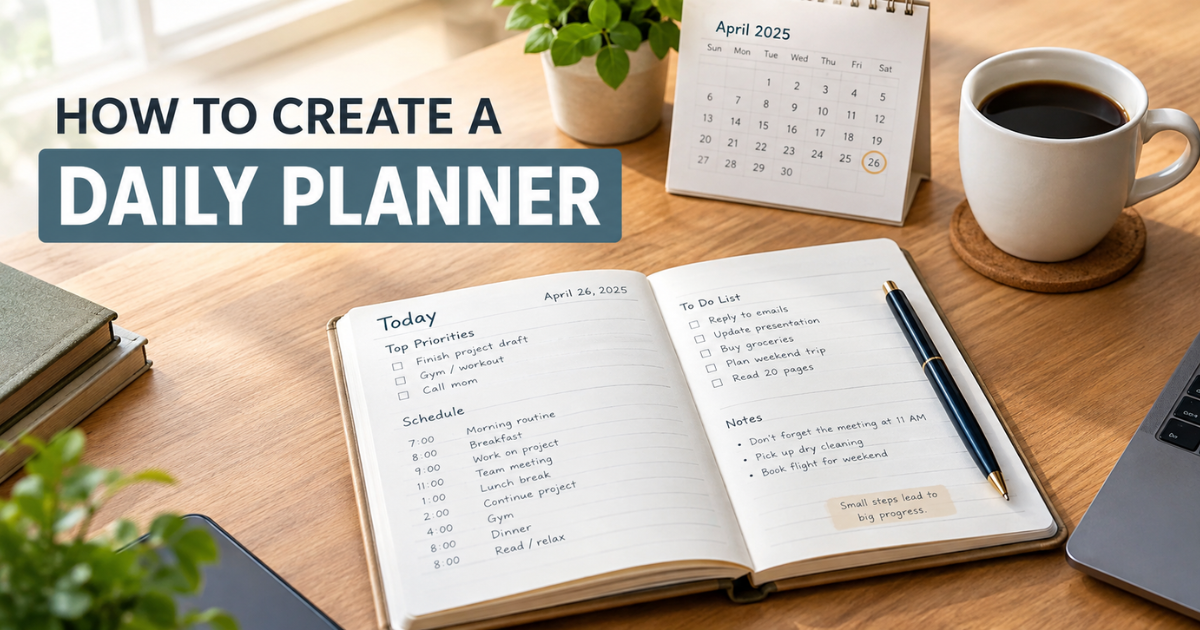
Here is a simple illustrative daily schedule:
| Time | Activity |
| 7:00 AM | Wake up and prepare |
| 8:00 AM | Breakfast and morning routine |
| 9:00 AM | Important work or study |
| 11:00 AM | Short break and smaller tasks |
| 1:00 PM | Lunch |
| 2:00 PM | Work, study, or appointments |
| 5:00 PM | Exercise or personal activities |
| 7:00 PM | Dinner and relaxation |
| 8:00 PM | Review tasks and prepare for tomorrow |
This is an example, not a schedule that everyone should follow. Your actual timetable should reflect your working hours, study commitments, sleep needs, and personal responsibilities.
5. Estimate How Long Each Task Will Take
A common planning problem is assuming that every task will be completed faster than it realistically can.
When you create a daily planner, estimate how long an activity may require. Include preparation, transitions, and potential interruptions when they are relevant.
For example, if you plan to study for one hour, you may also need time to gather your materials, take a short break, or move to another activity.
You do not need perfectly accurate estimates. The purpose is to make your schedule more realistic and identify when you have too many tasks planned for the same period.
A useful approach: Compare your planned schedule with the time you actually spend. Over time, this can help you improve future estimates.
6. Add Breaks and Flexible Time
A daily planner should not contain continuous work from morning until night.
Breaks provide space between activities, while flexible time helps you respond to delays, unexpected tasks, or activities that take longer than expected.
For example, if a meeting ends late, you may need to move a less urgent task to another time. A schedule with no flexibility makes these changes more difficult.
Instead of treating every empty period as wasted time, use some of it as a buffer. The amount you need depends on your routine and how unpredictable your day tends to be.
7. Include Personal Goals and Important Habits
Your planner can include more than work and study.
You may want to make time for exercise, reading, family activities, personal projects, or other meaningful habits. Include these activities when they genuinely fit your daily responsibilities.
For example, you could write:
- Walk for 20 minutes.
- Read for 15 minutes.
- Prepare materials for tomorrow.
- Spend time with family.
Avoid adding too many habits simply because they appear productive. A daily planner should reflect what you can reasonably maintain, not an ideal schedule that becomes difficult to follow.
8. Review Your Planner at the End of the Day
Take a few minutes to review your schedule before the day ends.
Ask yourself which tasks were completed, which activities took longer than expected, and whether anything needs to be moved to another day.
An unfinished task is not automatically a planning failure. It may have been less important than an unexpected responsibility, or its estimated duration may have been inaccurate.
Move unfinished tasks thoughtfully. If something is no longer important, remove it. If it is still necessary, assign it a realistic place in a future schedule.
How to Design a Daily Planner That Is Easy to Use
The design of your planner can influence how quickly you understand and update it. A useful layout should make important information easy to find.
Use Clear Sections
A simple daily planner might contain the following areas:
Today’s date: Identify the day you are planning.
Top priorities: Record the tasks that deserve the most attention.
Schedule: Add appointments, time blocks, and planned activities.
Task list: Include smaller activities that can be completed when time is available.
Notes: Leave space for reminders or changes.
End-of-day review: Record what was completed and what needs attention later.
You can combine these sections into a single page or spread them across a digital planning interface.
Keep the Layout Simple
Avoid filling your planner with decorative elements that make the information harder to read. A clear layout with consistent headings and enough writing space is often easier to use.
If you are designing a printable planner, consider whether the text is readable when printed and whether the writing areas are large enough for your typical tasks.
If you are creating a digital planner, consider whether you can quickly add, edit, and move tasks.
The right design depends on your preferences and how you intend to use the planner.
Paper Daily Planner vs. Digital Daily Planner
Both paper and digital planners can help organize a day. The differences mainly relate to how you record information, update schedules, and access your plans.
| Factor | Paper planner | Digital planner |
| Writing | Handwritten | Typed or entered digitally |
| Schedule changes | Usually manual | Often easier to edit |
| Reminders | Requires manual checking | May support notifications |
| Accessibility | Depends on carrying the notebook | May be available across devices |
| Layout | Can be customized by hand | Can offer templates and digital views |
| Best fit | People who prefer physical writing | People who prefer flexible digital tools |
Neither format automatically produces better planning. The more useful choice is the one that fits your habits, needs, and willingness to maintain the system.
Common Daily Planning Mistakes to Avoid
Planning Too Many Tasks
A long task list may look productive, but it can make it difficult to identify what matters most. Prioritize important work and allow for realistic completion times.
Ignoring How Long Activities Take
If you regularly schedule more work than the available time allows, review your estimates. Include time for breaks and transitions when necessary.
Making the Schedule Too Rigid
Unexpected responsibilities can affect your day. Leave some flexibility so that one delay does not disrupt the entire schedule.
Copying Unfinished Tasks Forever
Repeatedly moving the same task to tomorrow without reconsidering it can make your planner less useful. Decide whether the task should be completed, divided into smaller steps, rescheduled, or removed.
Spending More Time Designing Than Planning
A visually attractive planner can be enjoyable, but design should support practical use. Do not let decoration or template customization replace the planning process.
How to Make Your Daily Planner More Effective
A planner becomes more useful when you learn from your actual routine.
Plan Around Your Real Responsibilities
Build your schedule around fixed commitments first. Then add important tasks and flexible activities around the time that remains.
Break Large Tasks Into Smaller Actions
A large task can be difficult to begin when its next step is unclear. Instead of writing “Complete project,” you might write “Review project requirements” or “Draft the introduction.”
Smaller actions can make the next step easier to understand, although the time required will depend on the task.
Use a Consistent Review Routine
You can review your planner in the morning, the evening, or both. Choose a routine that fits your schedule.
A morning review can help you understand the day’s priorities. An evening review can help you adjust plans based on what actually happened.
Update the Planner When Your Day Changes
Your planner is a working tool, not a permanent promise that every activity will happen at an exact time.
If your circumstances change, adjust the schedule. This helps keep the plan useful instead of forcing you to follow an arrangement that no longer fits.
What Should You Include in a Daily Planner?
A practical daily planner may include the date, important tasks, appointments, a schedule, notes, and a short review section. You can add other sections based on your personal needs.
For example, a student may need a study timetable, while a professional may need meeting times and project deadlines. A person focusing on personal routines may prefer to include exercise, household responsibilities, and habits.
Start with the information you actually use. You can add more sections later if they provide a clear benefit.
Is It Better to Plan Your Day the Night Before or in the Morning?
Either approach can work. Planning the night before gives you an opportunity to identify the next day’s priorities, while planning in the morning allows you to account for current circumstances and changes.
A combined approach is also possible: prepare a rough plan the night before and review it in the morning.
The best method depends on your routine, the predictability of your commitments, and when you prefer to organize your tasks.
How Many Tasks Should You Put in a Daily Planner?
There is no universal number of tasks that everyone should plan. The appropriate amount depends on the time available, the complexity of your responsibilities, and the number of fixed commitments.
Focus on realistic priorities instead of choosing a target number of tasks simply to make your planner appear full.
Can a Daily Planner Help With Procrastination?
A daily planner may help by turning unclear intentions into specific tasks and planned time blocks. However, planning alone does not guarantee that procrastination will stop.
If a task feels difficult to start, define a manageable first action and assign it a realistic time. You can then review whether the planned approach worked and adjust it when necessary.
Should You Use a Daily Planner Every Day?
Daily planning can be useful for people who benefit from organizing their tasks, but the frequency and level of detail are personal choices.
Some people may prefer a detailed daily schedule, while others may use a short task list and a calendar. If daily planning takes too much time or creates unnecessary pressure, simplify the process.
Is Creating a Daily Planner Worth It?
Creating a daily planner can be worthwhile when it helps you understand your priorities, organize your responsibilities, and use your available time more deliberately. Its value depends on how well it fits your actual life, not how elaborate the template looks.
Start with a simple format, identify your important tasks, estimate the time you need, and review your plan as your day develops. With consistent adjustments, you can create a planning system that is easier to maintain and more relevant to your personal goals.
Aapke article ke liye professional, natural conclusion:
Conclusion
Creating a daily planner does not require a complicated system. Start by identifying your most important tasks, organizing them around your fixed commitments, estimating realistic time, and leaving enough flexibility for unexpected changes.
The most effective daily planner is one that matches your real routine and is simple enough to use consistently. Whether you prefer a notebook or a digital tool, review your plan regularly and adjust it based on what actually works. Over time, this simple habit can make your days more organized, focused, and manageable.
You may also like: plangud
FAQs
1. Is a detailed daily planner better than a simple one?
Not necessarily. A detailed planner provides more scheduling information, while a simple planner may be easier to maintain. The appropriate level of detail depends on your responsibilities and personal preferences.
2. Should I avoid using a daily planner if I have an unpredictable schedule?
No. You can use a flexible task list, broad time blocks, and adjustable priorities instead of assigning every activity a fixed time.
3. Can daily planning affect long-term productivity?
A daily planner can support progress by helping you organize actions related to longer-term goals. Its effect depends on how you use the plan and whether the tasks meaningfully contribute to your objectives.
4. What do people often overlook when making a planner?
Many people overlook the time required for transitions, interruptions, and routine activities. Including these considerations can make a schedule more realistic.
5. What should I do if I keep failing to follow my planner?
Review whether the tasks, time estimates, and schedule match your actual circumstances. Reduce unnecessary complexity, identify the cause of repeated problems, and adjust the planning method instead of automatically adding more tasks.
Share this content: