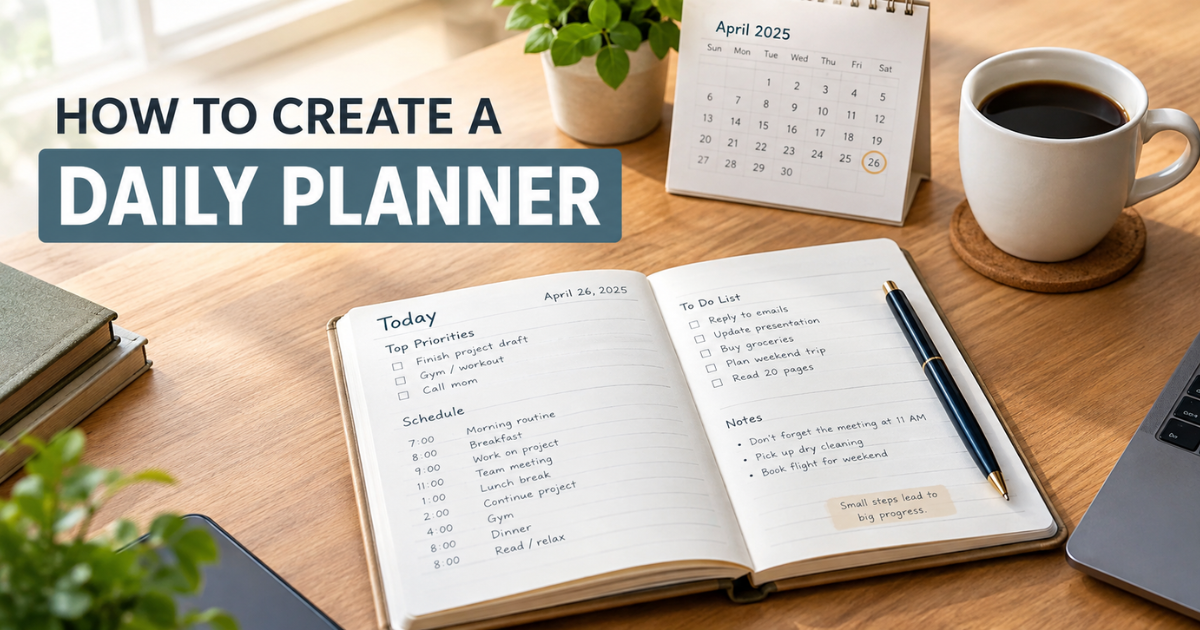

The best weekly planning tips for productivity do not involve filling every hour of your calendar. They help you decide what matters, give important work a realistic place in the week, and leave enough flexibility for the unexpected.
A productive week is not necessarily the week in which you complete the most tasks. It is the week in which your available time is directed toward the work that matters most.
What Is Weekly Planning and Why Does It Help?
Weekly planning is the process of looking at the week as a whole before it becomes crowded with meetings, messages, errands, deadlines, and last-minute requests.
Instead of deciding what to do from scratch every morning, you make several important decisions in advance. You identify the outcomes that matter, check your existing commitments, estimate your available capacity, and decide where the most important work belongs.
The key benefit is clarity. A weekly plan gives you a reference point when the day becomes noisy. You may still need to change the schedule, but you do not have to rethink your priorities every time something unexpected happens.
Current productivity guides commonly describe effective weekly planning as a repeatable cycle of reviewing, prioritizing, scheduling, and adjusting rather than a one-time list of tasks.
Start by Reviewing the Week You Just Finished
Before building a new plan, look backward for a few minutes.
Notice which tasks were completed, which ones were carried forward, where delays appeared, and which commitments consumed more time than expected. This is more useful than simply copying unfinished tasks into a new list.
An unfinished task can mean several different things. It may still be important, it may have been estimated incorrectly, or it may no longer deserve space on your schedule. Treating every unfinished item as automatically important creates a weekly plan that becomes heavier over time.
The review should therefore answer a practical question: what did last week teach you about this week’s available time?
Choose Fewer Priorities Instead of Planning Everything
One of the easiest ways to create an unrealistic week is to call everything a priority.
A better approach is to identify the small number of outcomes that would make the week genuinely successful. A priority should describe something meaningful you want to move forward, not simply a collection of minor actions.
For example, “prepare the client proposal” is a clearer weekly outcome than “work on proposal.” The first describes an intended result, while the second can expand indefinitely.
Once the main priorities are clear, smaller tasks can support them instead of competing equally for attention.
Build Your Week Around Real Capacity
Your task list may contain more work than your calendar can physically hold. That is normal. Productivity problems often begin when people plan from the size of the task list instead of the amount of time actually available.
Start with fixed commitments. Meetings, appointments, classes, travel, family responsibilities, and other non-negotiable activities consume capacity whether they appear on your task list or not.
Then look at what remains.
This simple step changes weekly planning from “How can I fit everything in?” to “What deserves the space I actually have?”
Current planning guidance similarly emphasizes starting with fixed commitments and treating the remaining time as a limited resource rather than an unlimited container.
Put Important Work on the Calendar
A priority that exists only on a to-do list is still competing with everything else.
Time blocking gives an important task a specific place in the week. Instead of writing “finish report,” you might reserve a focused period on Tuesday morning for the report. This does not guarantee completion, but it turns an intention into a concrete appointment with yourself.
You do not need to divide every minute of the week. Overly detailed schedules can become difficult to maintain and may leave no room for normal disruptions.
The more useful question is whether the work that matters has enough protected time to happen.
Match Difficult Work to Your Best Focus Periods
Not every part of the day feels equally suitable for demanding work.
Some people find that analytical work is easier early in the day. Others may focus better later. The important point is not to copy someone else’s “perfect productivity hour,” but to observe your own pattern.
Use your strongest periods for work that benefits from concentration and decision-making. Routine administration, simple communication, and low-focus tasks can often be placed in less demanding periods.
This is one reason weekly planning can be more effective than daily task lists alone: it gives you enough visibility to distribute different types of work across the week.
Leave Space for Interruptions and Delays
A full calendar can look productive while being extremely fragile.
Meetings run late. Tasks take longer than expected. Someone needs an answer. A deadline moves forward. A personal responsibility appears unexpectedly.
A practical weekly plan therefore needs open space.
Buffer time is not wasted time. It is capacity reserved for reality.
Recent weekly-planning guidance increasingly emphasizes leaving room for unexpected work rather than building schedules that assume every planned activity will take exactly as long as expected.
When a week contains some flexibility, a small disruption does not automatically require rebuilding the entire schedule.
Turn Goals Into Specific If–Then Plans
Planning becomes stronger when a goal is connected to a clear situation and response.
Instead of saying, “I need to work on my course this week,” create a more specific rule such as, “If it is 7 p.m. on Tuesday, I will study for 45 minutes at my desk.”
This is known as an implementation intention. Research has found that specifying when, where, and how an intended action will happen can help translate goals into behavior. A large 2024 meta-analysis found positive effects across hundreds of tests, although the size of effects varied across circumstances and outcomes.
The practical lesson is simple: do not only decide what you want to accomplish. Decide when the action is supposed to begin.
Create a Weekly Plan You Can Adjust Without Starting Over
A good plan is not a rigid contract.
Suppose an important meeting takes two hours instead of one. If your entire week is tightly connected, that single change can create a chain reaction. If the plan contains priorities, protected blocks, and some open capacity, you can move a task without losing the overall direction of the week.
Think of your weekly plan as a framework rather than a prediction.
The goal is to know what deserves protection, what can move, and what can be dropped when capacity disappears.
What to Do When Your Weekly Plan Falls Apart
When a week goes badly, resist the temptation to add more tasks to compensate.
First, identify what actually changed. Was there too much work? Were deadlines unrealistic? Did urgent requests consume the available time? Did the plan ignore fixed commitments?
Then reset from the current situation rather than from the original schedule.
Choose the most important remaining outcome, protect the next realistic block of time for it, and postpone or remove lower-value work. A weekly system becomes useful when it helps you recover, not only when everything goes according to plan.
How to End the Week With a Better Plan for the Next One
The final part of weekly planning is the review.
Look at what was completed, what moved forward, what repeatedly caused delays, and which tasks should no longer be carried into another week.
The purpose is not to judge yourself. It is to improve the planning system.
For example, if a two-hour task regularly takes four hours, the problem may not be motivation. Your estimates may simply be too optimistic. If meetings repeatedly destroy your focus blocks, the issue may be scheduling rather than discipline.
Small adjustments accumulate. A weekly review turns planning into a learning process instead of repeating the same schedule and hoping for a different result.
Is Weekly Planning Worth the Effort?
Weekly planning is worth the effort when it reduces daily decision-making without creating a second job called “managing your productivity.”
The strongest approach is usually simple: review the previous week, select a small number of meaningful priorities, check real capacity, schedule important work, protect focus time, and leave room for change.
You do not need the perfect planner or the most complicated productivity system. You need a weekly plan that reflects the time you actually have and makes the next important action easier to see.
Conclusion
The most useful weekly planning tips for productivity are not about packing more activities into seven days. They are about deciding what matters before the week becomes noisy, matching priorities to realistic capacity, and creating enough flexibility to keep the plan usable when circumstances change.
A simple weekly review, a small set of meaningful priorities, protected focus time, realistic buffers, and specific action plans can turn weekly planning from a long checklist into a practical operating system for the week ahead.
You may also like: Financial Planning for Beginners
FAQs
Is planning every hour of the week a good idea?
Not usually. Planning every minute can make your schedule too rigid and leave no room for interruptions. It is generally more practical to schedule important priorities and fixed commitments while keeping some flexible time available.
Should I avoid weekly planning if I already use a daily to-do list?
No. A daily to-do list helps you manage immediate actions, while weekly planning gives those tasks a wider direction. Using both can help you connect daily work with your most important weekly priorities.
Can weekly planning improve long-term productivity?
Yes, especially when you review the results of each week. Comparing planned work with what actually happened can help you improve time estimates, reduce unrealistic commitments, and make plans more practical.
What do people often overlook when planning a week?
Available capacity is one of the most commonly overlooked factors. Meetings, appointments, communication, travel, household responsibilities, and unexpected tasks all consume time, even when they are not included on a task list.
What should I do when I have too many important tasks?
Do not assume everything has to fit into the same week. Decide which outcomes matter most, schedule those first, and then postpone, delegate, simplify, or remove lower-priority work. A realistic plan is more useful than an overloaded one.
Use weekly planning tips for productivity to set realistic priorities, protect focus time, manage workload, and build a flexible plan you can follow.
Share this content: