Most articles on this topic tell you the same three things like canopy tents look professional, they protect against weather, and they double as a “mobile billboard.” All true and all also said a hundred times already.
What doesn’t get talked about nearly enough is the actual math behind why a tent pays for itself, and the liability side of running an outdoor booth that almost nobody in this space addresses directly. Let’s go there instead.
The Real Numbers Behind Outdoor Business Events
Before getting into design and materials, it’s worth understanding why outdoor events are worth showing up for in the first place because the data behind them is stronger than most businesses realize.
According to CEIR (Center for Exhibition Industry Research), roughly four out of five people walking a trade show floor are actually authorized to make a purchasing decision for their company. That’s not foot traffic for the sake of foot traffic, that’s a floor full of people who can actually say yes on the spot.
The cost side backs this up too. Industry benchmarks put the cost of a typical trade show lead at around $142, compared to roughly $596 for a traditional field sales call. In other words, a well-run booth is one of the more efficient ways to generate a qualified lead, not just a nice-to-have marketing expense.
However, one aspect of this that is not always associated with the booth setup process is the fact that exhibiting companies that undertake pre-event promotion such as emails and social media communications or reaching out to registered participants actually receive 46% more booth visitors than the companies that rely only on walk-in attendees, according to CEIR.
This is important to note in light of the fact that the conversation surrounding the branded tents needs to be re-evaluated.
The Liability Angle Nobody Talks About
This is where most articles on pop up canopy tents omit the important aspect: outdoor gatherings entail a significant health risk, which has been documented, and shade is no longer seen as an optional amenity but as an obligatory one.
Statistics collected by the Bureau of Labor Statistics show that almost 480 American workers lost their lives to environmental heat exposure over an 11-year period between 2011 and 2022, with roughly 40 casualties per year, while many more cases of injuries severe enough to incapacitate people for a considerable amount of time have been noted over a comparable period of time.
There may be no final OSHA federal heat standard yet, but OSHA’s General Duty Clause currently protects workers from exposure to dangerous workplace conditions including extreme heat. The recommendations for heat stress are simple: it’s all about water, rest, and shade, and the recommendations apply whenever employees work outside.
In certain states, such as California, it is actually mandated to train employees on heat illness prevention when temperatures reach 80°F and provide sufficient water and shaded areas.
Employees working from a booth for 6 or 8 hours in July is a perfect example of when this law applies. It is not just a marketing tent that you use in order to make your booth look attractive; it is also a safety tool for the people who will be working from this booth.
It’s important for any event planning committee to keep in mind that if your booth does not have sufficient coverage from the sun, you aren’t just putting your employees at risk but putting your entire company at risk for the type of liability OSHA is currently going after through their NEP on heat stress.
The Tent Trap: A Hidden Rule That Can Shut Your Booth Down
There’s a second layer to this that almost never comes up in canopy tent content, and it has nothing to do with weather or branding. It’s a legal requirement that can end your event before it even starts.
400 Square Feet: The Invisible Line Nobody Warned You About
Under the International Fire Code, adopted in some form by most US municipalities, any tent or canopy over 400 square feet needs a fire permit before it ever goes up. That’s roughly a 20×20 footprint, which sounds generous until you realize how easily it sneaks up on you. Push two 10×10 tents together with no gap between them, and in many jurisdictions the combined “aggregate area” counts toward that limit even though each tent on its own looks perfectly small and harmless.
The Label You Can’t See From the Parking Lot (But the Fire Marshal Can)
Here’s the kicker: Even the tents below the 400 sq ft threshold have to be labeled with an NFPA 701 flame retardant rating – a permanently stitched label and an additional certificate which is supposed to be present on site. This is not a piece of paper for the sake of paper. Fire marshals conducting random inspections of markets, festivals, and expos can put your booth out of business right away, even if your tent is smaller than the limit.
Fifty States, Fifty Rulebooks: Why “Certified” Doesn’t Always Travel
Fire compliance isn’t one national rulebook, it shifts depending on where you’re setting up:
- California requires separate registration with the State Fire Marshal under Title 19, on top of (or instead of) NFPA 701.
- New York City runs its own fabric certification standard under Title 27, NFPA 701 alone isn’t automatically accepted.
- Boston takes it further and requires a use permit filed in advance for each individual fabric.
- Most other cities default to NFPA 701, but still expect documented proof, not just a claim on a product listing.
“Certified” on the Box Isn’t the Same as Certified in Real Life
The real risk hiding in all of this: a supplier advertising a “custom canopy tent” doesn’t automatically mean the fabric is certified. If a vendor can’t hand over an actual test report or certification number, the tent isn’t certified, it just says it is. Most businesses discover this the hard way, standing next to a fire marshal on the morning of the event. Fire code specifics vary by municipality and get updated periodically, so it’s worth confirming current requirements with your local fire marshal’s office before an event rather than assuming one city’s rules apply everywhere.
What Makes a Canopy Tent Actually Work at an Event
With the “why” out of the way, here’s what separates a canopy tent that earns its keep from one that just sits there.
Frame quality over frame size. Aluminum or steel frames with hexagon-shaped legs hold up significantly better in wind than standard square-leg designs, and better-built frames are typically rated to withstand winds in the 60-85 km/h range. This matters more than most buyers realize until they’ve watched a cheap frame fold in a gust.
Fabric that survives real sun exposure. UV-treated, waterproof polyester, often coated with PVC for extra durability, holds color and structural integrity across dozens of events instead of fading or cracking within a season.
Fast, low-effort setup. If your team is setting up in under 30 minutes without needing a toolkit, you’ll actually use the tent consistently instead of dreading the process at every event.
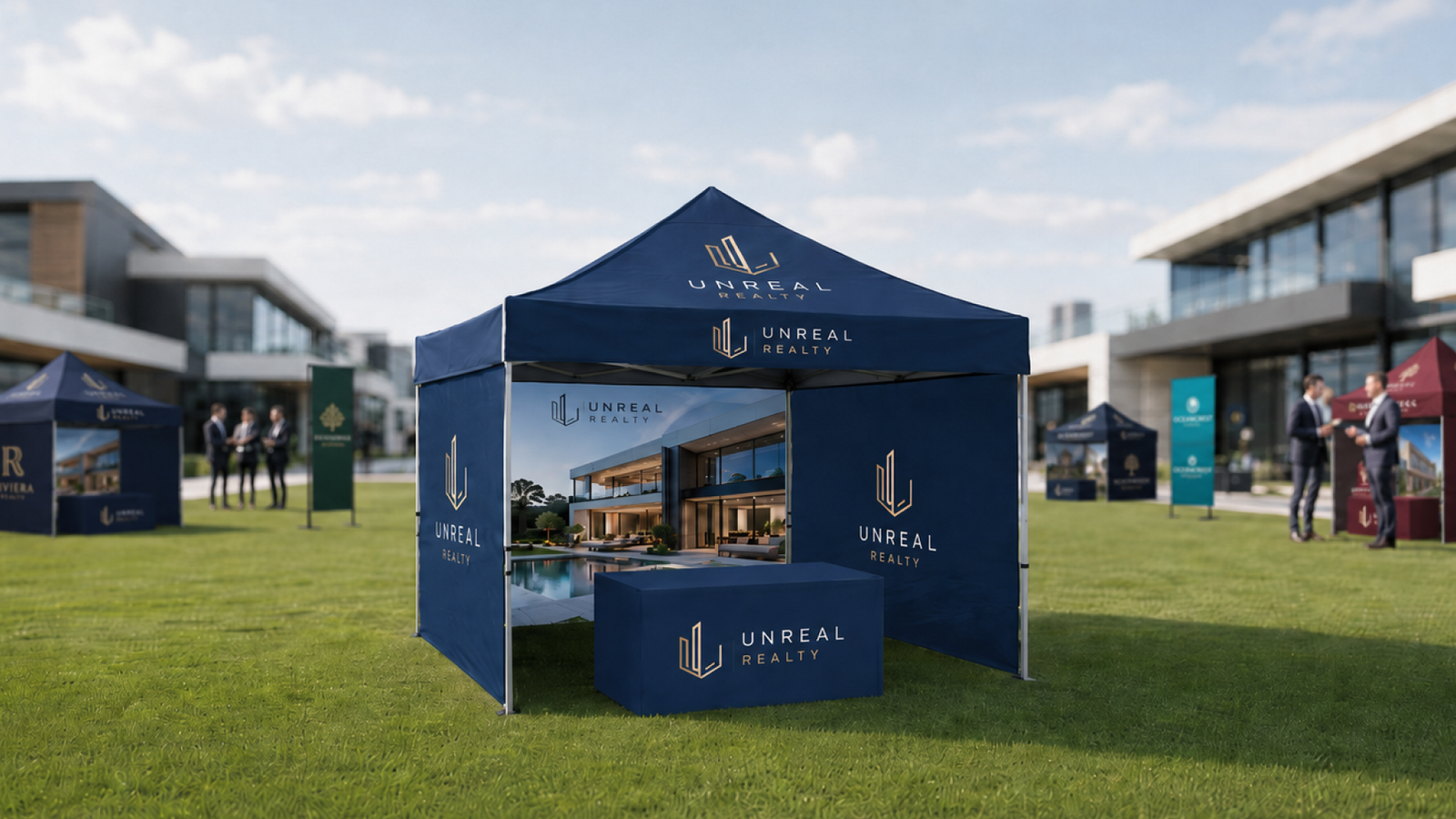
Enough branding real estate to matter. A 10×10 canopy top alone gives you meaningful surface area, but sidewalls, valances, and flags extend that space significantly useful if your message needs more than a logo and a tagline to land.
Where This Fits Into a Bigger Event Strategy
Pairing a strong outdoor setup with the kind of structured, branded presentation you’d normally see in Trade Show Booths -proper signage, clear product displays, consistent branding across every surface tends to outperform a great tent sitting next to a folding table and a stack of flyers. The tent gets people to stop. Everything else at the booth is what convinces them to stay.
The Bottom Line
The usual case for canopy tents is accurate branding, shelter, professionalism. The stronger argument is that outdoor events are a genuinely high-converting channel backed by real data, and the tent covering your booth is doing double duty as both a marketing asset and a basic safety measure for the people standing under it all day. Treat it as both, and it stops being a line item and starts being infrastructure your outdoor event strategy actually depends on.
Share this content: