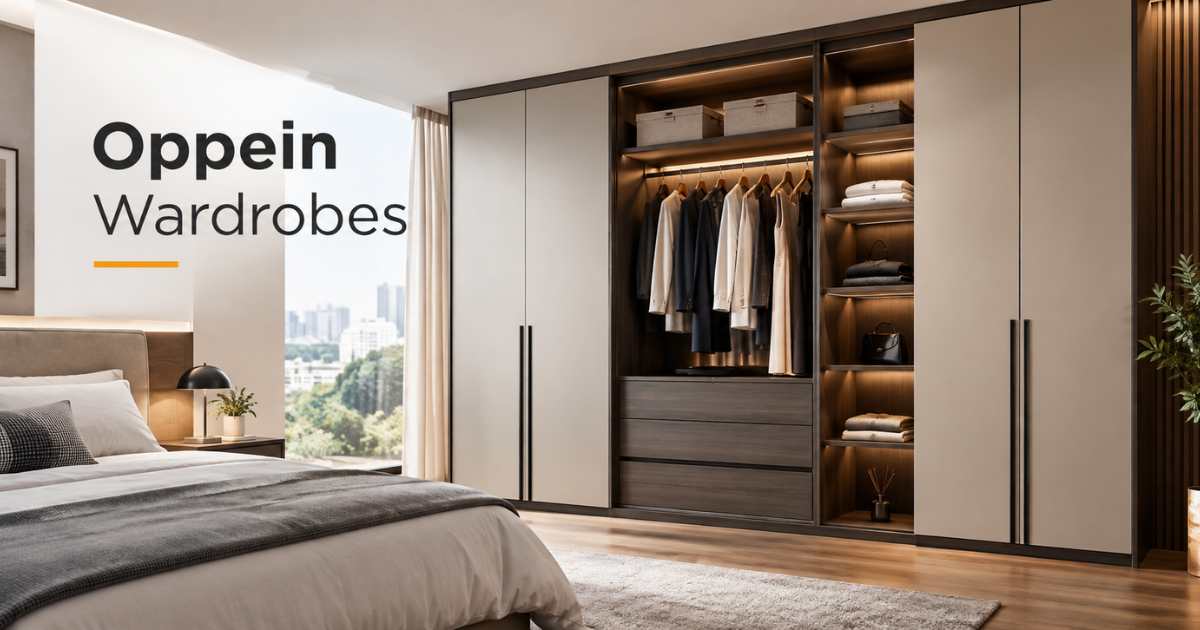
Oppein wardrobes are made-to-measure storage systems from OPPEIN, a Chinese home furnishing manufacturer that also makes kitchens, bathroom vanities, and interior doors. They suit people who want a fitted, designed wardrobe from one supplier, but price, finishes, and service depend heavily on which local dealer you deal with.
What does Oppein actually sell?
Wardrobes are one part of a wider catalogue. Oppein offers customized kitchen cabinets, wardrobes, bathroom vanities, interior doors, and other home furniture. In wardrobe terms, that generally means fitted sliding-door and hinged-door units, walk-in closets, and interiors with drawers, hanging rails, and shelving planned to your room.
Most showrooms present this as “whole-house customization,” meaning the wardrobe is designed to match the kitchen and doors. That is convenient if you want a matching look. It is unnecessary if you only need one wardrobe.
Who makes Oppein, and how big is the company?
The company was established in 1994 and grew from a kitchen cabinet maker into a broader home furnishing company. It went public on the Shanghai Stock Exchange in 2017. A September 2026 press release says the brand was ranked Global No. 1 in customized home furnishings for 2025 by Frost & Sullivan.
Treat that as a company-promoted ranking, not an independent verdict on wardrobe quality. Size tells you a brand can produce at scale. It does not tell you how your specific wardrobe will be built or installed.
Showroom counts vary by source, from roughly 8,000 to over 10,000, so quote none of them as fact without checking the current official figure.
How does ordering a custom Oppein wardrobe work?
The exact process varies by dealer, but custom wardrobes follow a similar pattern:
- Consultation and site measurement. A designer visits, or you supply accurate measurements.
- Design and quote. You review a layout, finishes, and hardware, usually with a 3D render.
- Factory production. Panels are cut and finished to your dimensions.
- Delivery and installation. Fitting is done on site.
Ask each dealer for the lead time between approval and installation in writing. It is the detail people most often discover too late.
What do the materials claims really mean?
Company materials say the panels used are E1 or CARB compliant, which are emission classes for formaldehyde in wood-based boards. The company also says it uses HOMAG woodworking lines.
Both are manufacturer statements. E1 and CARB are minimum-style compliance classes, not quality grades. They say nothing about how well a door hangs or how the drawer runners hold up after five years. Ask the dealer which board type, thickness, and hardware brand your quote uses, and ask for the compliance documentation for that batch or product line.
What drives the price of an Oppein wardrobe?
I could not verify current prices, and they will differ by country, so here is what moves the number rather than a number:
- Total width and height (the main driver)
- Door type: sliding tracks and glass or mirrored panels cost more than plain hinged doors
- Finish: laminate vs lacquer vs veneer
- Interior fittings: drawers, pull-out racks, lighting, soft-close hardware
- Installation, delivery, and any wall or ceiling preparation
- Whether the quote is per linear metre or per project (a common source of confusion)
A quote-comparison scorecard you can copy
Here is the “only-here” tool of this article. Getting three quotes is easy. Comparing them fairly is hard, because each dealer bundles different things. Score each quote out of 5 on these criteria, weighted by what matters to you:
| Criterion | Weight | Quote A | Quote B | Quote C |
| Total installed price (all fees) | 30% | |||
| Board type and thickness stated | 15% | |||
| Hardware brand named | 15% | |||
| Lead time in writing | 15% | |||
| Warranty terms and who honours them | 15% | |||
| Design fit for your room | 10% |
Worked example (illustrative numbers only): if Quote A scores 4 on price, 3 on board, 2 on hardware, 4 on lead time, 3 on warranty, and 5 on design, the weighted score is 0.30×4 + 0.15×3 + 0.15×2 + 0.15×4 + 0.15×3 + 0.10×5 = 3.5 out of 5. Do the same for each quote, and the cheapest one may no longer come out ahead.
Oppein vs other ways to get a wardrobe.
Oppein is one route among several. A local carpenter can build exactly what you want and may be flexible on design changes. Modular systems from flat-pack retailers are cheaper and quicker but come in fixed sizes. Other custom brands compete on the same fitted-furniture model.
Oppein tends to make sense when you value a designed, factory-finished result and a single point of contact for several rooms. A carpenter may be better when your room is irregular, your budget is tight, or you want to inspect the work in progress.
Measuring and planning mistakes to avoid
- Trusting a single measurement. Walls are rarely straight. Measure width at the top, middle, and bottom.
- Forgetting skirting boards, sockets, and ceiling height changes.
- Ignoring door swing. Hinged doors need clearance, and in a small room sliding doors can be the better choice.
- Leaving no allowance for how you actually use clothes. Long hanging, folded storage, and shoes need different depths.
- Signing before the layout is fixed. Get the final drawing approved in writing.
Who should choose Oppein, and who should look elsewhere?
Consider Oppein if you want a fully fitted, designed wardrobe, may extend the look to a kitchen or doors, and can visit a showroom to check samples and the dealer’s reputation.
Look elsewhere if your budget is tight, your room has awkward angles a carpenter can handle better, or your local dealer cannot give a clear warranty and installation timeline. The brand is the same everywhere, but the buying experience is set by the dealer, so judge the dealer and the written quote first.
Comparison Table
| Option | Best for | Main advantage | Main limitation | Cost/value |
| Oppein-style custom brand | Fitted, matching whole-home look | Design service, factory finish | Depends on local dealer | Verify locally |
| Local carpenter | Odd rooms, flexible budgets | Full flexibility, on-site checks | Finish varies by maker | Verify locally |
| Modular/flat-pack | Fast, low-cost storage | Speed and low cost | Fixed sizes, less fitted look | Verify locally |
No prices are given because I could not verify reliable data.
Conclusion
Oppein wardrobes is a large, established manufacturer, but when you’re buying a wardrobe, the quote in your hands matters more than the brand name. Before you sign, make sure the board type and thickness, hardware brand, installation date, and warranty terms (including who honours the warranty locally) are all in writing. Compare at least two other quotes, one from a second custom dealer and one from a local carpenter, and judge them on the installed total, not the headline price. Check the final drawing against your own measurements at the top, middle, and bottom of the wall, and confirm door swing and ceiling height. If the dealer clears all of this, Oppein is a reasonable choice for a fitted, designed wardrobe, especially if you want it to match a kitchen or interior doors.
You may also like: Jernsenger
FAQs
Is a big brand always better than a local carpenter?
No. Scale helps consistency, but a skilled carpenter can beat a factory result in a tricky room.
Should I avoid Oppein?
Not by default. Avoid any supplier who won’t put board type, hardware, lead time, and warranty in writing.
How long will a custom wardrobe last?
It depends on the board, hardware, humidity, and daily load, not the badge. Ask about hinge and runner warranties specifically.
What do buyers overlook?
Site preparation and the gap between wall and ceiling, which can add cost or delay fitting.
How do I decide between two quotes?
Use the scorecard above and compare installed totals, not the headline price.
Share this content: