
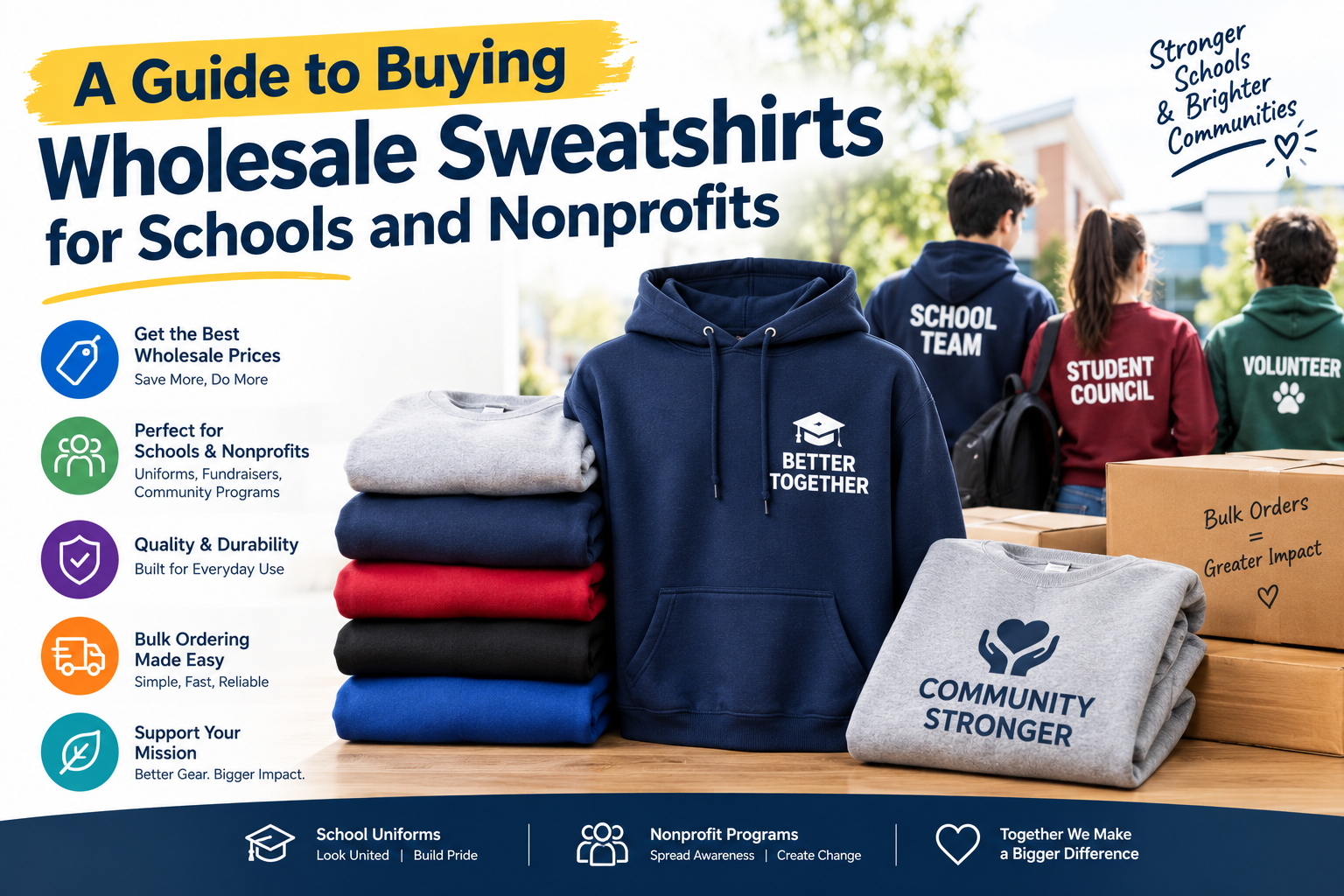
Balancing institutional procurement with strict fiscal accountability is a fundamental challenge for educational institutions, charitable foundations, community outreach centers, and non-profit organizations. When sourcing apparel for student cohorts, volunteer corps, annual fundraisers, or donor appreciation programs, committee treasurers and purchasing directors must maximize every budgeted dollar. Opting for low-end promotional fleece or fragmented retail purchases often leads to severe shrinkage, rapid color fading, and inconsistent sizing that undermines the organization’s public representation.
Securing high-grade fleece apparel within non-profit budgetary frameworks requires an understanding of textile economics, bulk distribution mechanics, and decoration compatibility. Rather than viewing bulk apparel as simple merchandise giveaways, organizers should approach fleece procurement as an investment in community visibility and organizational cohesion. Sourcing the right blank garments ensures lasting thermal comfort, dependable laundering performance, and a unified aesthetic that participants and supporters will wear proudly throughout the year.
Understanding Wholesale Supply Chains and Tiered Pricing Models
The primary financial advantage of bulk apparel procurement comes from bypassing secondary retail markups through authorized wholesale distribution networks. Commercial blank apparel distributors operate on high-volume, tiered pricing structures designed to reward bulk case purchases. Understanding these volume thresholds allows non-profit coordinators to consolidate departmental purchases—such as combining athletic booster orders with student council apparel—to reach higher-tier discounts that significantly lower the per-unit cost.
Purchasing through dedicated wholesale channels also shields organizations from localized retail shortages. Sourcing jerzees sweatshirts wholesale enables schools and non-profit foundations to secure dependable poly-cotton fleece manufactured with high-density stitch technology. These commercial blanks provide the pill-resistant durability needed to survive repeated industrial and domestic laundering, ensuring that student and volunteer apparel maintains a clean, uniform look long after distribution day.
Case-quantity purchasing also streamlines freight and handling logistics. Authorized distributors ship apparel in standardized, factory-sealed cartons containing uniform size-and-color assortments, which minimizes packing discrepancies and reduces warehouse handling costs for volunteer distribution teams.
Operational and Budgetary Benefits of Blank Crewneck Sweatshirts
When outfitting broad demographics spanning students, senior volunteers, faculty members, and community donors, silhouette versatility is essential for keeping costs manageable. While hooded garments and full-zip jackets remain popular casual choices, they incorporate additional hardware, drawstrings, and multi-panel hoods that significantly inflate the base manufacturing cost.
Integrating blank crewneck sweatshirts into an institutional purchasing plan provides significant financial and logistical benefits. The classic, collarless crewneck eliminates moving parts and excess fabric, resulting in a lower unit cost that allows tight budgets to stretch further across larger participant groups.
From an administrative perspective, the crewneck provides a universally flattering, non-restrictive cut that fits diverse age brackets and body types comfortably. This predictable, relaxed fit reduces sizing errors and minimizes post-distribution returns or exchanges.
The clean collarline also allows students and volunteers to layer the garment comfortably over collared uniform shirts, team polos, or volunteer vests, maintaining a smart, dress-code-compliant appearance during official school assemblies, charity galas, and public community activations.
Evaluating Fiber Blends for Institutional Longevity
Selecting the right textile blend is critical for ensuring that group apparel withstands the diverse demands of school life and community fieldwork:
Pure cotton fleece delivers a soft, natural hand-feel and exceptional breathability, making it well-suited for indoor classroom environments and sensitive skin. However, one hundred percent cotton is inherently vulnerable to dimensional shrinkage in hot tumble dryers, and it readily absorbs ambient moisture, which can leave outdoor volunteer crews feeling cold and damp during rainy morning events.
Fifty-fifty cotton-polyester blends represent the ideal operational balance for schools and non-profit organizations. The polyester fibers provide high tensile strength that resists fabric tears, minimizes shrinkage in commercial laundry cycles, and accelerates moisture evaporation, while the brushed cotton interior ensures soft skin contact and thermal comfort.
Synthetic performance fleece utilizes extruded polyester microfibers designed to wick sweat and dry rapidly, making it well-suited for athletic booster teams and physical fieldwork, though it carries a slightly higher unit price than standard blended fleece.
Maximizing Decoration Value on a Non-Profit Budget
Customizing apparel for schools and charities requires choosing an embellishment method that delivers high visual impact without exhausting the project budget. Print and embroidery costs are heavily influenced by the complexity of the artwork, the number of ink colors, and the total stitch count.
Traditional plastisol screen printing remains the most economical and durable decoration technique for large school and charity runs. By limiting the design to one or two high-contrast ink colors—such as white or gold on a navy or forest green garment—organizations can reduce screen preparation fees and press setup charges while producing bold, opaque graphics that withstand years of washing.
Water-based screen printing offers an ultra-soft, breathable finish on cotton-rich garments, absorbing into the fabric fibers rather than sitting on top, which is ideal for artistic club designs and eco-friendly non-profit campaigns.
Precision left-chest embroidery provides a sophisticated, professional finish tailored for faculty apparel, board member gifts, and corporate donor recognition programs, maintaining a crisp, distinguished appearance on stable fleece surfaces.
Managing Sizing Curves, Inventory Holds, and Lead Times
Successful bulk procurement requires proactive scheduling and methodical size forecasting. Non-profit initiatives often operate around immovable calendar dates, such as annual charity walks, fall pep rallies, or spring volunteer weeks. Delaying garment procurement until the final weeks introduces stock risks, limited color availability, and expensive rush shipping charges.
Purchasing coordinators should begin planning at least six to eight weeks in advance of the distribution date:
Collect accurate participant sizing through centralized digital surveys four to six weeks prior to production to establish precise case breakdowns and avoid excess inventory of outlier sizes.
Incorporate an intentional five to ten percent safety buffer across median sizes (medium, large, and extra-large) to accommodate last-minute volunteer registrations, new student transfers, or unexpected VIP guests on event day.
Request digital embroidery sew-outs or printed pre-production strike-offs from your decorator before authorizing full production, ensuring that school crests, organization logos, and sponsor tiers are accurately rendered and verified.
Sourcing Standards and Supply Discipline
Ensuring that school and non-profit apparel meets institutional expectations requires strict adherence to quality assurance standards. Sourcing coordinators should verify that blank garments utilize pre-shrunk fabrics to maintain sizing consistency throughout the school year.
Garments constructed with quarter-turned bodies eliminate the vertical center crease found in standard tubular knits, ensuring that printed crests and typographic logos sit straight across the chest without distortion.
Inspecting the recovery of elastane-reinforced ribbing on neckbands, cuffs, and waistbands ensures that the garments maintain their neat shape and draft-blocking seal, even after frequent wear in demanding volunteer settings.
Maximizing Community Impact Through Informed Procurement
Navigating wholesale sweatshirt procurement with clear technical intent allows educational and charitable organizations to make the most of their financial resources. Bypassing retail markups in favor of dependable bulk distribution channels guarantees consistent quality, reliable sizing, and durable fabric performance across every garment.
By balancing cotton softness with polyester strength, prioritizing versatile crewneck silhouettes, and selecting cost-effective decoration methods, purchasing committees can outfit their communities in apparel that builds lasting pride and unity.
A thoughtful procurement strategy transforms basic group apparel into a lasting asset for community engagement, keeping students, volunteers, and supporters comfortable, warm, and unified throughout every campaign.
Share this content: