
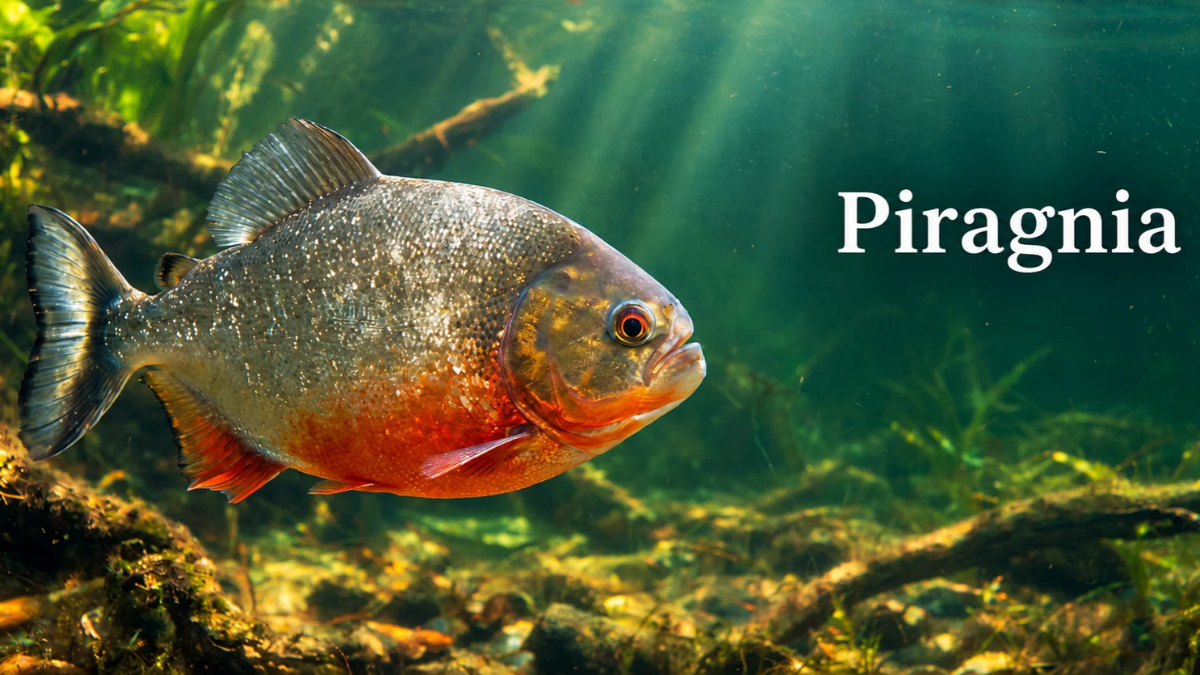
Piragnia does not appear in the authoritative fish references reviewed as an accepted scientific name for a separate fish species. In fish-related searches, it is best understood as a likely misspelling or informal variation of piranha, the familiar name for a group of South American freshwater fish.
The distinction matters because an unfamiliar word can look like an official biological term after it appears repeatedly online. Understanding Piragnia therefore requires looking at the spelling itself, checking reliable references, and separating uncertainty about the name from what scientists know about real piranhas.
What Does Piragnia Mean?
Piragnia is an unusual term whose exact origin has not been established by the reliable sources reviewed for this article. When it appears in discussions about sharp-toothed fish, South American rivers, or aquatic predators, its similarity to the word piranha provides the most plausible explanation.
However, that interpretation should not be confused with a verified etymology. There is not enough reliable evidence to establish when the spelling originated, who first used it, or why it appeared online.
A useful distinction is that a search term does not need to be an official scientific name to appear in articles, social posts, or search results. People can misspell unfamiliar words, remember their pronunciation incorrectly, or repeat an error from another source. Repetition may make a spelling more visible, but it does not establish a new biological classification.
For readers, the practical answer is straightforward: if you encountered Piragnia while reading about a fish with sharp teeth and a South American habitat, the intended subject is likely a piranha. If the word appears in another context, its meaning needs to be checked separately.
Is Piragnia a Real Fish?
The sources reviewed do not establish Piragnia as a recognized fish species. FishBase and the Smithsonian’s National Zoo instead document real piranhas under established biological names.
One example is the red-bellied piranha, scientifically known as Pygocentrus nattereri. The Smithsonian identifies this fish as a member of the family Serrasalmidae and describes its distinctive gray body, silver markings, reddish underside, and powerful jaws.
This is a useful example because it demonstrates how a genuine animal can be identified using a recognized common name and scientific classification. A separate animal would require supporting taxonomic evidence, not merely a similar-looking name on a website.
It is also worth remembering that piranhas are not a single identical type of fish. Different species can vary in appearance, habitat, and feeding behavior. Information about one species should not automatically be applied to every fish commonly called a piranha.
For that reason, an accurate article should explain the likely spelling connection first and then use established sources when describing the animal.
What Are Piranhas Really Like?
Piranhas are freshwater fish associated with South America. Although films often portray them as relentless predators, their actual behavior is more varied than that familiar image suggests.
Habitat and distribution
Red-bellied piranhas are native to the Amazon River basin, where they inhabit both still and moving freshwater environments. FishBase also records the species across additional South American river systems.
These environments support a wide range of aquatic life, and piranhas occupy a place within that larger food web. Their distribution is not limited to one famous stretch of the Amazon, and different species have different geographical ranges.
The distinction between the Amazon basin and South America as a whole is important: a reference to the Amazon describes a major habitat, not an exact location for every piranha species.
Diet and feeding behavior
The red-bellied piranha has a varied diet. According to the Smithsonian’s National Zoo, it may feed on pieces of flesh, small fish, insects, aquatic invertebrates, and plant material such as ripe fruit. It is also known for biting the fins of larger fish.
This diet illustrates why describing every piranha as a fish that exclusively eats large animals is misleading. Feeding behavior depends on factors such as species, available food, and circumstances.
Some piranhas are important scavengers as well as predators. By feeding on available animal material, they participate in the natural processes that move energy through freshwater ecosystems.
The most accurate explanation is therefore more nuanced than the popular image of an animal that attacks everything in its path.
Teeth and physical features
The red-bellied piranha has a compact body, a rounded head, strong jaw muscles, and triangular teeth that fit together closely. These features help it bite and cut its food effectively.
Its reddish underside and silvery markings are also characteristic features described by the Smithsonian. The teeth are impressive, but their presence alone does not mean that the fish constantly seeks opportunities to attack humans.
Understanding the difference between physical capability and typical behavior is essential when evaluating claims about potentially dangerous wildlife.
Are Piranhas Dangerous to Humans?
Piranhas can bite people, and their powerful jaws can cause serious injuries. However, the familiar story of entire schools instantly stripping a healthy person to the bone is not a reliable description of their usual behavior.
A scientific report published in Wilderness & Environmental Medicine examined piranha injuries in southeastern Brazil. It noted that severe stories about schools attacking people have limited supporting evidence, while real injuries can occur in rivers and lakes. The report also discussed bites associated with fish defending their young.
National Geographic has likewise reported that piranha bites are uncommon relative to the frightening reputation these fish have acquired.
The reasonable conclusion is neither that piranhas are harmless nor that every encounter is life-threatening. They are wild animals with the ability to inflict injuries, and their behavior depends on the species and situation.
Anyone visiting a river or lake in a region where piranhas occur should follow local safety advice, pay attention to warning signs, avoid handling or feeding wild fish, and stay out of restricted areas. Local knowledge is more useful for making a safety decision than sensational stories or dramatic movie scenes.
Why Does the Spelling Cause Confusion?
Several explanations are possible for an unfamiliar spelling like Piragnia. Someone may have typed the name incorrectly, remembered it from hearing it spoken, or copied it from a website that already used the variant.
These are plausible explanations, not confirmed facts about the word’s history. No reliable source reviewed here establishes a single origin for Piragnia.
Online repetition can add to the confusion. Once an unusual term appears on several pages, a reader may assume it refers to a rare species or a newly discovered animal. But repeated publication does not replace evidence from scientific references or recognized taxonomic records.
This is also why an article about an obscure keyword should not invent a dramatic origin story simply to make the subject appear more important. Explaining the limits of the available evidence is more useful than presenting a guess as a discovery.
How Can You Verify What Piragnia Means?
Start with context. If the word appears alongside references to sharp teeth, South American freshwater habitats, or the Amazon River basin, piranha is a reasonable interpretation to investigate.
Next, check a dependable animal reference. FishBase provides information about recognized fish species, while the Smithsonian’s National Zoo offers accessible descriptions of red-bellied piranha biology and habitat. Scientific studies can provide additional evidence when the question concerns human injuries or animal behavior.
Compare the spelling, scientific name, physical description, and geographical information. If a page claims Piragnia is a newly discovered species, look for a credible scientific reference supporting that specific claim.
If the term appears in a business name, fictional story, product description, or another unrelated setting, do not automatically assume it refers to a fish. The surrounding context may change the likely interpretation, and that alternative meaning should be verified independently.
The guiding principle is simple: use the closest plausible interpretation when evidence supports it, but keep the difference between a verified fact and a reasonable guess clear.
What Should Readers Understand About Piragnia?
Piragnia is best treated as an uncertain spelling associated with piranha when the context concerns freshwater fish. The sources reviewed support the existence and biology of recognized piranha species, including the red-bellied piranha, but do not establish Piragnia as a separate scientifically recognized animal.
For readers who simply want to understand the word, this distinction resolves most of the confusion. For students, researchers, or wildlife enthusiasts, the next step is to use established species names and reliable references rather than rely on an unfamiliar spelling alone.
The broader lesson is that a convincing word is not necessarily an official name. Checking the evidence helps distinguish an online spelling variation from a real biological classification—and leads to a more accurate understanding of the animal behind the search.
Comparison Table
A short comparison is useful because it resolves the principal spelling confusion.
| Term | What the evidence supports |
| Piragnia | An uncertain term, plausibly a spelling variation of piranha in fish-related contexts |
| Piranha | An established common name for South American freshwater fish |
| Red-bellied piranha | A documented species with the scientific name Pygocentrus nattereri |
Conclusion
Piragnia remains an uncertain term, but in fish-related contexts, it most plausibly refers to piranha, a recognized group of South American freshwater fish. Although the spelling itself has not been verified as an accepted scientific name, established references provide reliable information about piranha species, their habitats, feeding behavior, and potential risks to humans. Understanding this distinction helps readers separate online spelling variations from verified biological facts.
Before accepting claims about Piragnia as a separate species, check trustworthy scientific sources and look for evidence supporting its classification. This evidence-based approach offers a clearer understanding of the term without confusing speculation with established knowledge.
You may also like: Pomerusky
FAQs
Is Piragnia a separate fish species?
The authoritative fish sources reviewed do not establish Piragnia as a separate recognized species. In fish-related contexts, it is most plausibly a spelling variation of piranha.
What is the difference between Piragnia and piranha?
The main difference is that piranha is an established common name, while Piragnia remains an uncertain spelling in the available evidence.
Where do piranhas live?
Piranhas are South American freshwater fish. The red-bellied piranha is native to the Amazon River basin and is also recorded in other South American river systems.
Are piranhas dangerous to humans?
They can inflict serious bites, but sensational claims about constant, coordinated attacks exaggerate their typical behavior. Follow local warnings and safety guidance in piranha habitats.
Can Piragnia mean something other than a fish?
Possibly. The context may point to a name, fictional term, product, or another use, but no separate established meaning was verified in the research conducted for this article.
Piragnia is usually a spelling variant of piranha, not a recognized fish species. Explore real piranha facts, habitat, diet, behavior, and safety.
Share this content: