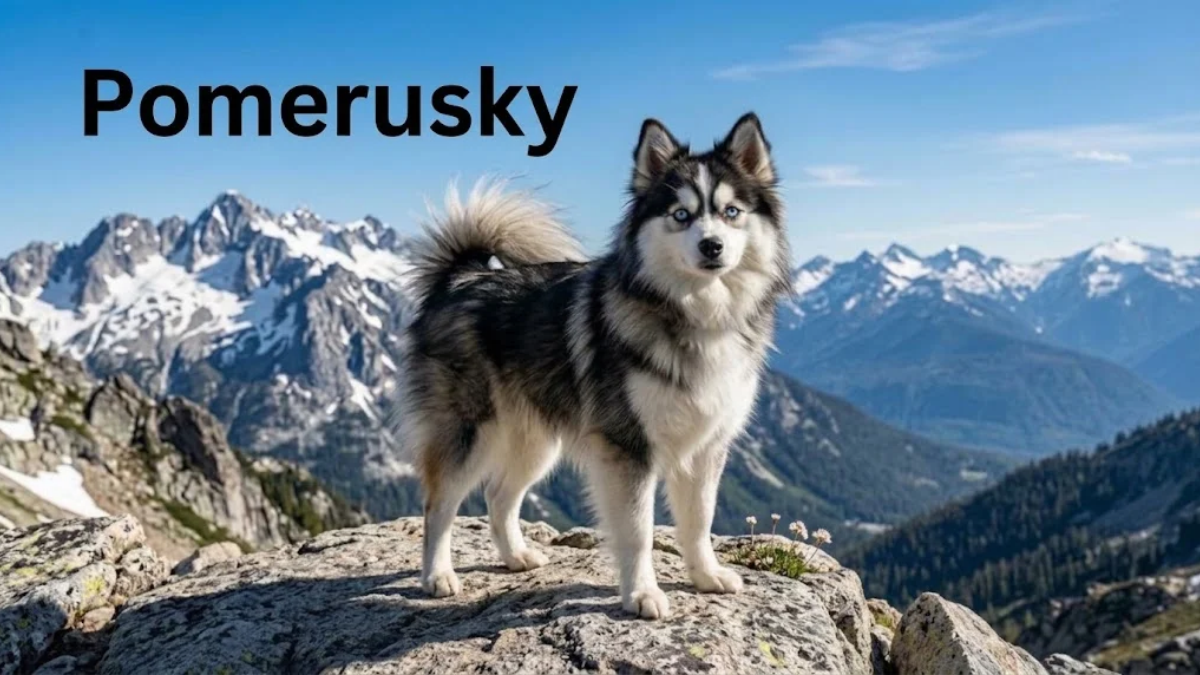
A Pomerusky is generally used to describe a Pomeranian and Siberian Husky mix, more commonly called a Pomsky. It is a mixed or designer dog rather than a standardized purebred, so its adult size, appearance, coat, and temperament can vary substantially from one dog to another.
What Is a Pomerusky?
The word Pomerusky combines the names of its two parent breeds: the Pomeranian and Siberian Husky. In current search results, the term is commonly used as an alternative name for the Pomsky, while veterinary sources such as PetMD primarily use Pomsky.
The cross became known in the early 2010s. PetMD reports that Pomskies have been around since about 2012, with first-generation puppies produced using a Siberian Husky mother and Pomeranian father through artificial insemination because of the large difference in size between the parent breeds.
That history matters because a Pomerusky is not simply a predictable “small Husky.” It is a combination of two genetically and physically different breeds.
Pomerusky vs. Pomsky: Are They the Same?
For most searches, Pomerusky and Pomsky refer to the same basic Pomeranian–Siberian Husky cross. “Pomsky” is the much more established term in veterinary and pet-care resources, while Pomerusky appears as a variation used by websites and breeders.
This naming difference can create confusion when researching puppies. Someone searching only for Pomerusky may miss useful veterinary information because much of the stronger information is published under Pomsky.
The practical rule is simple: when researching a Pomerusky, search both names and pay more attention to the dog’s actual parentage, health records, and individual characteristics than to the label itself.
Why Does the Pomerusky Look So Different From One Dog to Another?
This is one of the most important things potential owners should understand.
The Pomeranian is a tiny toy breed. The AKC lists it at about 6–7 inches tall and 3–7 pounds, while the Siberian Husky is substantially larger, with listed adult weights of roughly 35–60 pounds depending on sex.
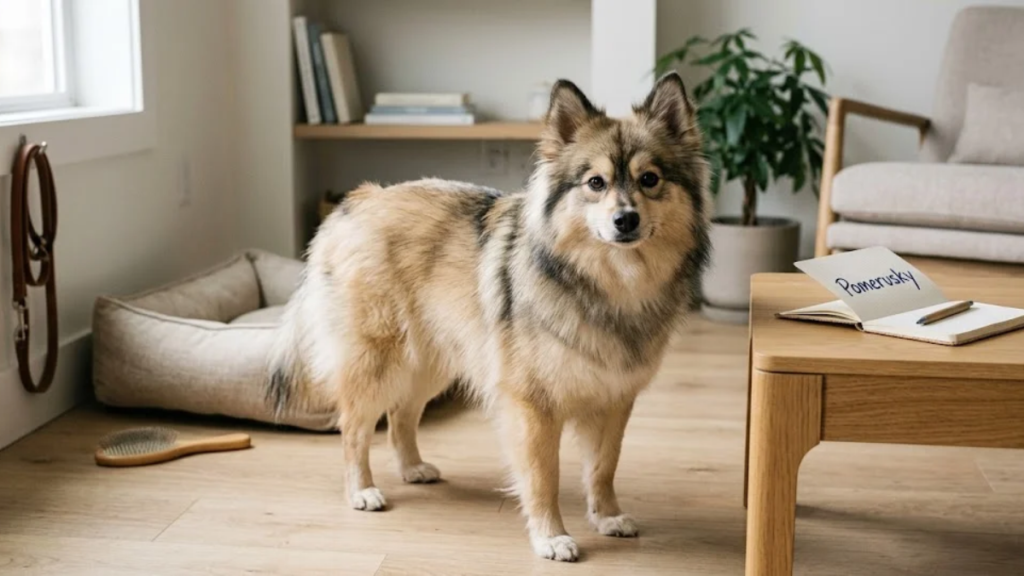
Because the parental genetics are so different, puppies can inherit different combinations of traits. One Pomerusky may have a stronger Husky appearance, while another can have a smaller frame, heavier fluff, or more obvious Pomeranian characteristics.
Eye color, facial markings, coat texture, body structure, and adult size should therefore be treated as variable traits, not guarantees.
This is also why attractive puppy photographs can create unrealistic expectations. A very young dog may change considerably as it matures.
How Big Can a Pomerusky Get?
There is no single adult size that applies to every Pomerusky.
PetMD describes Pomskies as varying broadly, with a commonly cited adult range of approximately 12–35 pounds, while Petfinder gives a broader range and emphasizes that parentage and individual genetics matter.
The better way to estimate an individual puppy’s eventual size is to look at the actual parents and the puppy’s generation rather than trusting labels such as “mini,” “toy,” or “standard.”
Even responsible breeders cannot guarantee an exact adult weight for every mixed-breed puppy.
What Is a Pomerusky’s Temperament Like?
A Pomerusky can inherit characteristics from both parent breeds, so temperament is not perfectly predictable.
PetMD describes Pomskies as intelligent, active and strongly attached to their people. They can need both physical exercise and mental stimulation, and boredom may contribute to undesirable behaviors. Early training and socialization are particularly useful.
The Siberian Husky itself is an energetic working dog developed for endurance, while the Pomeranian is a small but active and intelligent companion breed.
In practical terms, a Pomerusky should not automatically be treated as a low-energy lap dog simply because it may be smaller than a Husky.
Some individuals can also be vocal, independent,t or stubborn. These traits are better managed through consistent, reward-based training rather than punishment.
How Much Exercise and Training Does It Need?
A Pomerusky usually needs more than occasional trips outside.
Daily walks, play, training exercises, and mentally stimulating activities can all help meet its needs. PetMD lists activities such as walking, hiking, running, agility, nose work, obedience trainin,,g and food puzzles among suitable enrichment options.
Training should begin early and remain consistent. Short sessions using rewards are generally more practical than long, repetitive sessions.
A particularly useful ownership test is to ask: Can I provide regular physical activity, training and human interaction for the entire life of this dog?
That question is more valuable than simply asking whether a Pomerusky “looks easy to handle.”
What Does Pomerusky Grooming Involve?
Pomeruskies commonly have dense double coats because both parent breeds have thick coats.
PetMD reports that brushing requirements vary with coat type, with some Pomskies needing brushing two or three times a week and additional grooming during heavier shedding periods.
Owners should expect loose hair and regular coat maintenance rather than assuming the small size means low grooming effort.
The coat also should not automatically be shaved simply because it is thick. PetMD notes that a Pomsky’s coat can provide protection from environmental conditions, and shaving should generally be avoided except when medically necessary or otherwise appropriate.
What Health Issues Should Owners Understand?
There is an important limitation here: the Pomsky is relatively new, so long-term breed-specific health data are more limited than for established purebred dogs.
PetMD discusses reported concerns including patellar luxation, allergies, and hip dysplasia, while also emphasizing the importance of responsible breeding and health testing. These should be treated as potential concerns, not predictions that every Pomerusky will develop them.
One of the strongest practical checks is therefore the health history of the parents.
The AKC lists recommended testing for Pomeranians that includes patella, cardiac,c and ophthalmologist evaluations. For Siberian Huskies, recommended testing includes hip evaluation, ophthalmologist evaluation, Siberian Husky Shaking Puppy Syndrome Type 1, and Siberian Husky Polyneuropathy Type 1.
OFA’s CHIC program also explains that breed-specific health screening results can help buyers and breeders make better-informed decisions, although screening does not guarantee a perfectly healthy dog.
What Should You Ask a Pomerusky Breeder?
Instead of asking only, “How much is the puppy?”, ask for evidence.
A responsible buyer should want to see the puppy’s parentage, veterinary records, ds and relevant health-testing documentation. OFA explains that its public records can be used to research health-screening information for dogs when those results have been submitted and released.
Also ask how the puppies are socialized, what food they are eating, what vaccinations and veterinary care they have received, and what the breeder knows about the parents’ temperaments.
The best question is often not “Is this puppy rare?” but “Can you show me evidence that these parent dogs were responsibly selected?”
Is a Pomerusky Good for Families and Apartments?
Potentially, yes—but the individual dog matters more than the label.
PetMD notes that Pomskies can adapt to apartments and different living environments when their mental and physical activity needs are met. It also emphasizes proper introductions and supervision around children and other animals.
An apartment does not automatically make the dog unsuitable. Likewise, having a large yard does not automatically solve exercise or training needs.
A better match depends on the household’s routine, time, experience, tolerance for shedding and barking, and ability to provide daily engagement.
Pomerusky vs. Pomeranian vs. Siberian Husky
| Factor | Pomerusky | Pomeranian | Siberian Husky |
| Type | Mixed/designer dog | Purebred | Purebred |
| Parentage | Pomeranian × Siberian Husky | Established breed | Established breed |
| Adult size | Highly variable | Very small | Medium |
| Coat | Usually dense/double | Dense/double | Dense/double |
| Exercise | Individual but often active | Moderate | High |
| Predictability | Lower | Higher | Higher |
| Breed standard | No uniform purebred standard | Established | Established |
The biggest difference is predictability. The Pomeranian and Siberian Husky each have established breed standards, while a Pomerusky can inherit different combinations of traits.
Who Should and Shouldn’t Choose a Pomerusky?
A Pomerusky may fit someone who likes intelligent, interactive dogs and is prepared for regular grooming, training,g and exercise.
It may be a poor match for someone looking for a completely predictable adult size, a low-maintenance coat, or a dog that can comfortably be ignored for most of the day.
The most important decision factor is not whether the dog looks like a miniature Husky. It is whether the individual dog and the owner’s lifestyle are genuinely compatible.
Conclusion
A Pomerusky is best understood as a variable Pomeranian–Siberian Husky mix, usually called a Pomsky, rather than as a standardized purebred with guaranteed characteristics. Its appeal comes from the combination of the two parent breeds, but that same combination means adult appearance, size, and behavior can differ considerably.
The strongest buying decision is therefore based on parent health testing, individual temperament, realistic size expectations, grooming requirements, training needs, and long-term veterinary care.
That is the key point many surface-level Pomerusky guides miss: the name may describe the mix, but the individual dog determines what living with one will actually be like.
You may also like: plangud
FAQs
Is “Pomerusky” an official separate dog breed?
No separate standardized purebred status should be assumed from the name. Current veterinary sources primarily use Pomsky for the Pomeranian–Siberian Husky cross, and Hill’s identifies the Pomsky as a mixed-breed dog without a standardized appearance or temperament.
Should I avoid a Pomerusky because it is a mixed breed?
No. Being a mixed or designer dog is not, by itself, enough reason to reject one. The more useful questions concern responsible breeding, parent health testing, temperament, veterinary care and whether the dog’s needs fit your household.
Does owning a Pomerusky become easier when the dog gets older?
Some training challenges can become easier as a dog matures, but grooming, exercise, social interaction and veterinary responsibilities remain long-term commitments. Do not choose one assuming puppy behavior will simply disappear without training.
What is the most overlooked practical issue?
Predictability. Buyers often focus on a puppy’s current appearance, but a young Pomerusky may not grow into the exact size, coat or facial appearance expected from photographs.
What should I check before paying for a puppy?
Check the parents’ identities, available health-testing records, veterinary documentation, socialization practices and the breeder’s willingness to answer detailed questions. OFA explains that its database can be used to investigate publicly released health-screening results.
Share this content: