Kotora Melnkalne is a phrase associated with Kotor, a historic coastal city in Montenegro known for its striking natural setting and preserved architectural heritage. Nestled between rugged mountains and the Bay of Kotor, the city combines centuries-old stone buildings, narrow streets, churches, and fortifications with a distinctive Adriatic atmosphere. Exploring what Kotora Melnkalne means offers a useful introduction to Kotor’s history, cultural significance, and appeal as a destination in Montenegro.
What Does Kotora Melnkalne Mean?
Kotora Melnkalne refers to Kotor, Montenegro, rather than a separate hidden city or newly discovered destination. The Latvian National Library’s geographic-name database records “Kotora (Melnkalne)” as a geographic name and provides Kotor, Montenegro as its English equivalent.
This distinction matters because someone searching the exact phrase may initially expect to find an unusual village, region, or independent tourist destination. In practical travel research, however, the name to use is Kotor, Montenegro.
Is Kotora Melnkalne a Separate Place?
No. The evidence available from the Latvian geographic-name authority points to Kotor rather than a separate location. Its database also provides related geographic forms, including “Melnkalne–Kotora.”
That makes the keyword particularly interesting from a search perspective: the unusual phrase is real as a geographic-language form, but the destination itself is the well-established city of Kotor.
For hotel searches, maps, transportation information, sightseeing resources, and official tourism information, using Kotor, Montenegro will generally produce the clearest results.
Where Is Kotor, Montenegro?
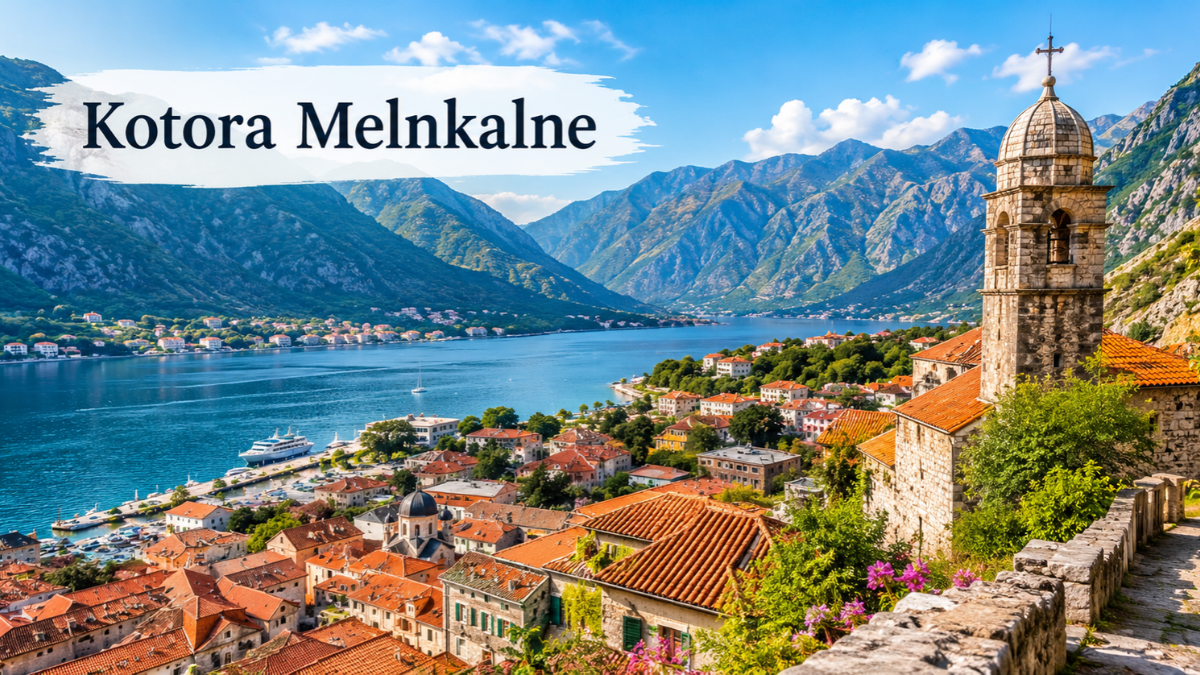
Kotor is located on the Bay of Kotor, also known as Boka Kotorska, along Montenegro’s Adriatic coast. The city sits in a dramatic landscape where mountains rise steeply around the protected bays. UNESCO describes the protected region as covering the best-preserved inner southeastern part of Boka Kotorska, with surrounding mountains rising rapidly to almost 1,500 metres.
The geography is one of Kotor’s defining characteristics. Instead of looking like a conventional flat Mediterranean resort, the historic settlement is tightly connected to the water, mountain slopes, defensive walls, and surrounding communities.
Montenegro’s tourism authority highlights the Bay of Kotor for activities ranging from boat trips and sailing to hiking, kayaking, cycling, and other outdoor experiences.
Why Is Kotor Historically Important?
Kotor is significant because its importance comes from both culture and landscape. UNESCO describes the area as a natural harbour on the Adriatic that became an important artistic and commercial centre during the Middle Ages, with established traditions of masonry and iconography.
The city also carries strong Venetian architectural influences from centuries when Kotor was connected to the Venetian sphere. Historic stone buildings, churches, palaces, public squares, and fortifications remain central to its identity.
Kotor’s heritage is not limited to one building. The protected cultural landscape connects architecture, settlements, the bay, and the surrounding terrain.
What Is Kotor Old Town Like?
Kotor’s Old Town is the part most visitors associate with the city. Narrow stone streets lead between old buildings, churches, squares, cafés, and historic structures enclosed by defensive walls.
The official Kotor tourism site describes the Old Town as a medieval environment featuring ancient walls, palaces, churches, and narrow streets.
Important landmarks include the Cathedral of St. Tryphon, the Church of St. Luke, the Church of St. Mary, and the historic Clock Tower. Montenegro’s official tourism information also identifies the Church of Our Lady of Health and other heritage buildings within the Kotor area.
The best way to appreciate the Old Town is not simply to move from one landmark to another. Walking without rushing reveals how closely the buildings, lanes, squares, and fortifications fit together.
What Makes the Bay of Kotor Special?
The Bay of Kotor gives the city much of its visual identity. Deep blue-green water, steep mountains, historic settlements, and small coastal communities create a landscape that is unusually compact and dramatic.
Montenegro’s official tourism site lists the bay at about 87.3 square kilometres, with a coastline of roughly 105.7 kilometres. It also promotes the region for boating, sailing, hiking, kayaking, and related outdoor activities.
For travelers, this means Kotor does not need to be treated as a destination limited to its Old Town. The wider bay is part of the experience, and exploring beyond the historic walls can give a better sense of the landscape in which the city developed.
What About Kotor’s Fortress?
Kotor’s defensive heritage is another major part of the destination. The fortification system climbs the mountain above the historic town, creating a powerful connection between the city and the surrounding terrain.
The Montenegrin tourism authority notes that Kotor Fortress forms part of a wider defensive heritage associated with the Venetian Republic’s military system known as Stato da Mar.
This is also useful context for understanding why Kotor looks the way it does. The walls were not decorative additions; they were part of the city’s historical defensive infrastructure.
Why Is Kotora UNESCO World Heritage Destination?
The Natural and Culturo-Historical Region of Kotor was inscribed on the UNESCO World Heritage List in 1979. UNESCO recognizes the area for its combined cultural and natural significance, including historic architecture, settlements, and the surrounding landscape.
The site has also faced serious challenges. UNESCO notes that the 1979 earthquake caused major damage to monuments in the region, after which extensive restoration work took place, including support from UNESCO.
That history is important for visitors because Kotor is not simply an attractive backdrop. It is a protected cultural landscape whose buildings and setting require ongoing conservation.
Is Kotora Better for History or a Beach Holiday?
Kotor is particularly strong for travelers interested in history, architecture, scenery, walking, cultural heritage, and coastal landscapes.
It can be part of a wider Montenegro beach trip, but its strongest identity is different from a conventional beach resort. The Old Town, fortress, historic buildings, bay views, and nearby settlements provide much of the destination’s appeal.
The best experience is therefore likely to come from combining time in the historic centre with exploration of the wider Bay of Kotor rather than treating the city only as a place to sit by the water.
What Should First-Time Visitors Know?
The most useful practical lesson is to separate the search phrase from the official destination name.
Search engines may surface “Kotora Melnkalne,” but travelers should use Kotor, Montenegro when looking for official information, maps, accommodations, transportation, and attractions.
It is also worth remembering that the UNESCO designation applies to a broader cultural and natural region rather than just a collection of picturesque streets. Respecting historic buildings, religious sites, local communities, and conservation requirements is part of responsible travel.
Is Kotora Melnkalne Worth Visiting?
The keyword itself is not a reason to visit, but the place behind it certainly offers substantial reasons to consider a trip.
Kotor combines a historic walled town, Adriatic coastal scenery, mountain landscapes, maritime heritage, religious architecture, defensive structures, and a UNESCO-recognized cultural landscape. Those elements give it more depth than a destination chosen only for photographs.
For someone researching kotora melnkalne, the most useful next step is to stop searching for a mysterious location and begin researching Kotor itself.
Comparison Table
| Search term | What it refers to | Best use |
| Kotora Melnkalne | Latvian geographic form associated with Kotor, Montenegro | Understanding the unusual keyword |
| Kotor, Montenegro | Standard English geographic name | Maps, travel research, bookings |
| Bay of Kotor | Wider bay and surrounding region | Regional sightseeing and activities |
Conclusion
Kotora Melnkalne refers to Kotor, Montenegro, in Latvian geographic naming, not to a separate hidden destination. The Latvian National Library’s geographic database provides strong evidence for this connection and lists Kotor, Montenegro as the corresponding English geographic name.
The real destination is well worth understanding on its own. Kotor brings together a historic walled Old Town, churches, palaces, defensive structures, maritime heritage, and the spectacular setting of the Bay of Kotor. The Natural and Culturo-Historical Region of Kotor has been a UNESCO World Heritage property since 1979, reflecting the importance of both its cultural heritage and landscape.
You may also like: Mebalovo
FAQs
Is Kotora Melnkalne a real city?
It refers to the real city of Kotor in Montenegro, rather than a separate city.
Why does the name look different from Kotor, Montenegro?
The wording reflects Latvian geographic naming. The Latvian National Library records Kotora (Melnkalne) as a geographic form connected with Kotor, Montenegro.
Is Kotor a UNESCO site?
Yes. The Natural and Culturo-Historical Region of Kotor was added to the UNESCO World Heritage List in 1979.
Is Kotor mainly a beach destination?
Kotor is better known for its historic town, heritage, mountains, bay, and cultural attractions than as a conventional sandy-beach resort.
Should travelers search for Kotora Melnkalne or Kotor Montenegro?
For practical travel planning, Kotor Montenegro is the clearer search term because it is the standard English geographic name.
Share this content: