
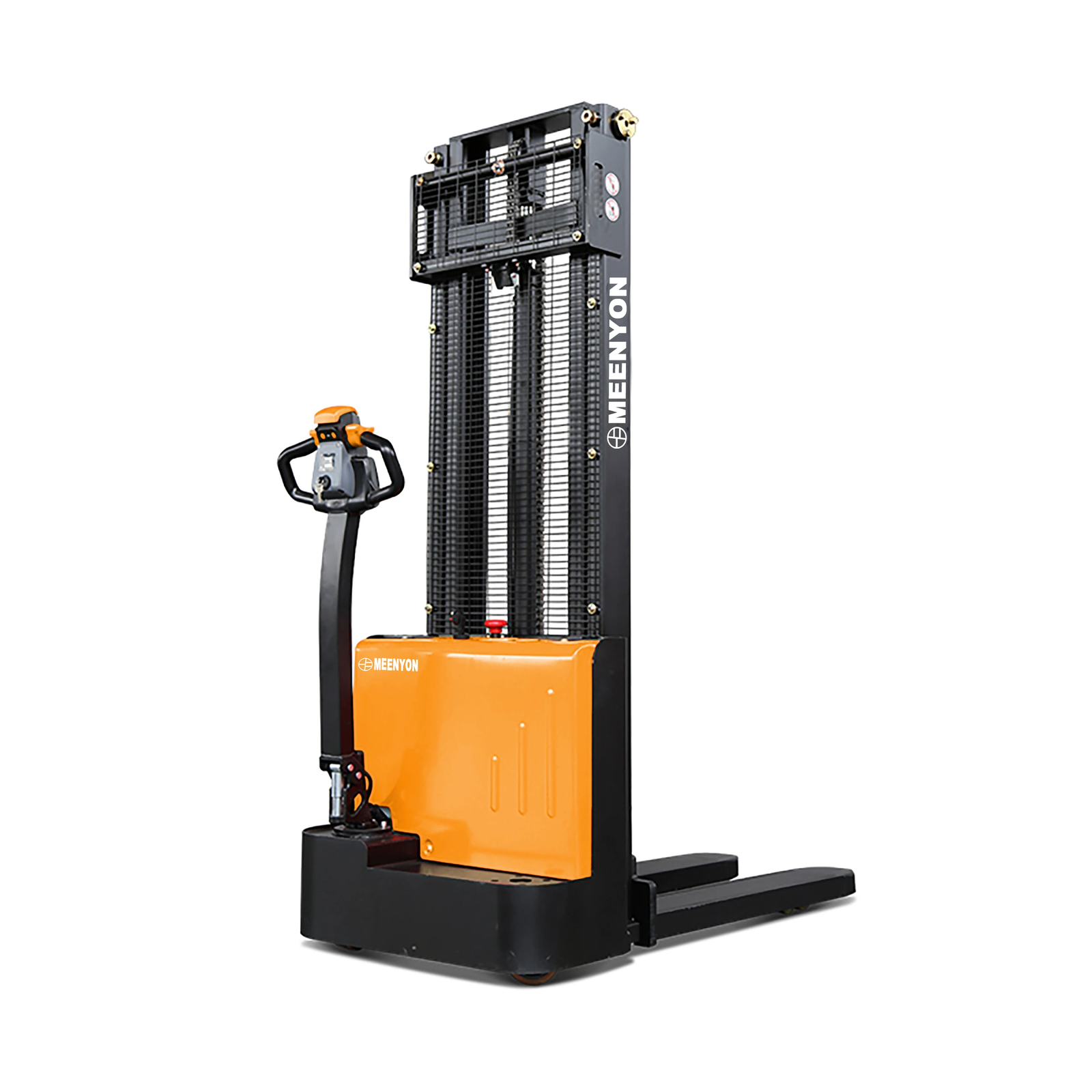
Narrow aisle warehousing is one of the more demanding applications for any stacking machine, and the consequences of a poor equipment choice compound quickly. A walkie stacker that is too wide for the aisle requires operators to manoeuvre on every approach, increasing cycle time and the risk of racking damage. One that lacks the stability for the racking height being used creates a genuine safety exposure. Getting the selection right requires matching several machine characteristics to the specific aisle dimensions and racking configuration of the facility.
Aisle width is the starting constraint
Before any other machine characteristic is considered, the actual usable aisle width needs to be confirmed. This means the clear working width available once loaded pallets on the floor and any fixed installations are accounted for, not the nominal structural aisle width.
A walkie stacker operating in a narrow aisle needs clearance on both sides during travel and during the final positioning manoeuvre into the racking bay. The machine’s overall width, the width at the stabiliser legs, and the turning arc required to enter and exit a bay all need to fit within this constraint. Machines that require tight operator manoeuvring on every cycle slow throughput and create repetitive collision risk.
Reach versus straddle design
The two primary design configurations for narrow aisle walkie stackers are reach and straddle.
A straddle walkie stacker has stabiliser legs that extend on either side of the pallet rather than underneath it. To pick up a pallet, the operator positions the machine so the legs straddle the pallet from the front. Straddle machines work well in dedicated narrow aisle environments where the floor-level pallet placement is consistent and the aisle is designed around the leg footprint.
A reach walkie stacker uses a telescoping reach mechanism to extend the forks into the racking bay without the machine itself moving into the rack face. The stabiliser legs remain in the aisle. This allows tighter aisle clearances during stacking and retrieval, at the cost of additional mechanical complexity and a higher acquisition cost.
The right design depends on the specific racking configuration, the depth of the bays being serviced, and the aisle width available.
Lift height and stability at height
Every walkie stacker has a rated capacity that decreases with lift height, and a stability envelope that narrows as the mast extends. In narrow aisle applications where the machine is working close to its maximum lift height routinely, the stability margins are tighter than they would be in a more open environment.
The machine’s rated capacity at the working lift height, not just at ground level, needs to match the actual load weights being handled. In narrow aisle racking environments that use every available vertical metre, confirming the machine’s capacity at the top rack level is a non-negotiable step in the selection process.
Floor condition and wheel configuration
Narrow aisles in high-density warehouses are often subject to floor wear from repeated machine passes at the same entry points. Tandem drive wheels, larger diameter wheels, or polyurethane wheel compounds all affect how a walkie stacker handles uneven or worn floor sections without pulling off the straight line the aisle demands.
A machine that tracks straight and maintains controlled steering in the aisle reduces operator correction effort on every cycle, which is a productivity and fatigue consideration across a full shift.
Operator ergonomics in confined operation
In a narrow aisle, the operator is working in a consistently constrained space with limited room to step aside or reposition. The tiller handle geometry, the effort required to operate the lift controls, and the visibility from the operator position to the racking bay all affect how comfortably and accurately the operator can work across a full shift.
Ergonomics in narrow aisle operation is not a luxury consideration. An operator who is physically fatigued or who has poor visibility to the bay they are filling makes errors that cost time and damage the product. Equipment selection should include an assessment of operator comfort and visibility specific to the aisle configuration being used.
Getting the specification right
The right walkie stacker for a narrow aisle application is the one whose width, stabiliser design, reach configuration, lift height capacity, and wheel specification match the actual working environment of the facility. No single machine specification suits every narrow aisle operation.
Toyota Material Handling Australia‘s product team can assess the aisle dimensions, racking height, and load requirements of a specific facility and recommend a configuration that works for the application. Contact the team to discuss the right solution for your operation.
Share this content: