UYÇ, commonly associated with the Ulusal Yeterlilik Çerçevesi (National Qualifications Framework), is a structured framework used to organize, describe, and compare qualifications based on defined learning outcomes. It helps clarify the knowledge, skills, and competencies associated with different levels of education and vocational achievement.
Understanding the UYÇ framework and qualification levels can be useful for students, professionals, educators, and anyone researching Turkey’s qualification system. While the terminology can sometimes be confusing, especially when comparing UYÇ with TYÇ (Türkiye Yeterlilikler Çerçevesi), understanding the difference makes it easier to interpret certificates, diplomas, vocational qualifications, and their corresponding levels.
What Does Uyç Mean?
Uyç, when used in the context of Turkish education and qualifications, most reliably refers to UYÇ, or Ulusal Yeterlilik Çerçevesi (National Qualifications Framework). It is a structured system for defining, classifying, and comparing qualifications rather than the name of one particular certificate or diploma.
The term can be confusing because people also encounter TYÇ, which means Türkiye Yeterlilikler Çerçevesi, or Turkish Qualifications Framework. The two expressions are closely related, but they are not exactly interchangeable.
What Is UYÇ?
A National Qualifications Framework provides a common structure for describing qualifications according to defined criteria. According to Turkey’s MYK, UYÇ helps integrate different qualification systems, improve transparency, and make qualifications easier to compare.
In practical terms, this means that qualifications from different parts of an education and training system can be organized within a common framework.
Instead of looking only at the title of a qualification, the framework considers what a person is expected to know, what they can do, and what level of competence they have achieved.
Is UYÇ the Same as TYÇ?
Not exactly.
UYÇ is the general concept of a National Qualifications Framework. TYÇ is Turkey’s specific implementation, called the Türkiye Yeterlilikler Çerçevesi. MYK describes TYÇ as Turkey’s national framework designed in alignment with the European Qualifications Framework and covering qualifications gained through general, academic, and vocational education and other learning routes.
This distinction is one of the most useful things to understand when researching Uyç.
A simple way to remember it is:
UYÇ = national qualifications framework concept
TYÇ = Turkey’s specific qualifications framework
How Does the Turkish Qualifications Framework Work?
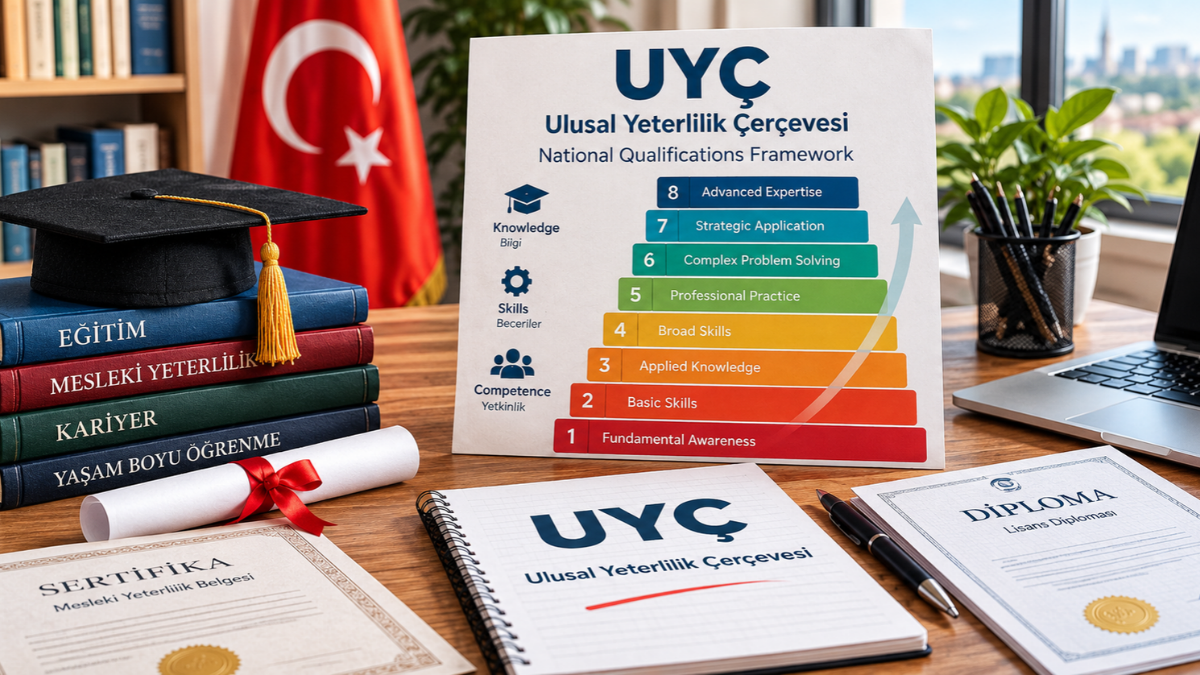
The Turkish framework organizes qualifications using eight levels. These levels move from simpler and more basic learning outcomes toward increasingly complex knowledge, skills, and competence.
The level system is not simply a ranking of school certificates. A level describes the expected learning outcomes associated with qualifications.
The official framework uses three major dimensions when describing learning outcomes: knowledge, skills, and competence.
That approach allows qualifications from different educational or vocational pathways to be understood using a common reference structure.
What Are the Eight Levels?
The TYÇ has eight levels, beginning at Level 1 and progressing to Level 8. The official descriptions show a gradual movement from the ability to perform basic tasks toward the ability to deal with complex problems and introduce innovation in a field of work or learning.
However, the level number should not be interpreted as meaning that every qualification at the same level is identical.
For example, the official framework explains that different qualification types may exist at the same level. Being placed at the same level establishes a comparable level of learning outcomes, but it does not automatically mean that one qualification can replace another or provide identical legal rights.
That distinction prevents a common misunderstanding about qualification frameworks.
What Does UYÇ Measure?
UYÇ is concerned with learning outcomes, rather than simply the amount of time someone spent studying.
This makes the framework useful for describing the actual knowledge, skills, and competence expected from a qualification.
According to MYK documentation, national qualification systems can support the classification of existing qualifications, the development of new qualifications, learning-outcome-based education programs, recognition of previous learning, and comparison of qualifications.
That makes the concept relevant to both formal education and vocational learning.
Why Is UYÇ Important for Students and Workers?
For students and learners, a qualifications framework can make educational pathways easier to understand. It can also support the recognition and progression of learning outcomes across different parts of the system.
For workers, vocational qualifications can provide a more structured way of describing professional knowledge and competence.
For employers, standardized qualification descriptions can make it easier to understand what a particular qualification represents.
MYK states that the framework was designed to improve transitions between qualifications, recognition of prior learning, employment opportunities, and access to learning.
These benefits depend on how qualifications are actually implemented and recognized, so the framework should not be viewed as a guarantee of employment or automatic equivalence between certificates.
Who Manages the Framework in Turkey?
Turkey’s qualifications system involves several institutions. The Vocational Qualifications Authority (MYK), the Ministry of National Education (MEB/MoNE), and the Council of Higher Education (YÖK/CoHE) have important responsibilities in the framework.
MYK has a central role in developing and maintaining the national framework and coordinating relevant processes.
National vocational qualifications also go through defined development, assessment, approval, and certification procedures.
How Does UYÇ Connect to Europe?
One of the major purposes of a national qualifications framework is comparability.
The European Qualifications Framework (EQF) provides a broader reference structure that can help countries relate their qualification systems to one another. MYK explains that the European framework is intended to support transparency, recognition, and comparison between different national systems.
The European Training Foundation reports that Türkiye adopted its Turkish Qualifications Framework in 2015, with eight levels, and updated its referencing to the EQF in 2025.
This international connection is particularly relevant when qualifications are being considered across education, employment, and mobility contexts.
Why Do People Confuse Uyç, UYÇ and TYÇ?
The confusion mostly comes from abbreviations.
A search for “Uyç” may lead to pages using different capitalization or discussing the term without explaining the Turkish qualification context. Some newer websites also describe lowercase “uyç” as a flexible digital or internet expression, but those explanations do not have the same authority as the terminology used by Turkey’s official qualification bodies.
For a serious education, vocational, or certification query, the safest approach is to check the context.
When the surrounding words include education, certificate, qualification, MYK, learning outcomes, vocational skills, TYÇ, or EQF, UYÇ is most likely referring to the National Qualifications Framework.
Comparison Table
| Term | Meaning | Role |
| UYÇ | Ulusal Yeterlilik Çerçevesi | General national qualifications framework concept |
| TYÇ | Türkiye Yeterlilikler Çerçevesi | Turkey’s specific qualifications framework |
| EQF / AYÇ | European Qualifications Framework | European reference framework |
A Practical Way to Understand UYÇ
Think of UYÇ as a common map for qualifications. A certificate, diploma, or other qualification contains information about what someone has learned or is capable of doing. The framework provides a structured way to position and describe that qualification.
The important question therefore is not simply, “What certificate is this?”
A better question is:
“What learning outcomes does this qualification demonstrate, and at what level?”
That perspective makes UYÇ much easier to understand.
What UYÇ Does Not Mean
UYÇ is not the name of a single university, a single vocational certificate, or a single examination.
It also does not mean that two qualifications at the same level are automatically identical.
The official Turkish framework specifically recognizes that different qualification types can share the same level while remaining different qualifications with different rights, purposes, and responsible institutions.
This is an important limitation when comparing qualifications.
Conclusion
The clearest and best-supported meaning of Uyç is UYÇ, Ulusal Yeterlilik Çerçevesi, or National Qualifications Framework, when the keyword is used in a Turkish education and qualification context. UYÇ provides a structured way to define, classify, and compare qualifications, while TYÇ is the specific Turkish Qualifications Framework built around eight levels and learning outcomes.
For anyone researching a Turkish certificate, diploma, vocational qualification, or professional skill, the most useful next step is to identify the qualification itself, its TYÇ level, its learning outcomes, and the institution responsible for it. That gives a much more accurate picture than relying on the abbreviation Uyç alone.
You may also like: CISM vs CRISC
FAQs
Is Uyç a certificate?
No. In the Turkish qualifications context, UYÇ refers to a framework for organizing and comparing qualifications rather than one individual certificate.
Is UYÇ the same as TYÇ?
No. UYÇ is the general national qualifications framework concept, while TYÇ is Turkey’s specific framework.
Does the same TYÇ level mean two qualifications are identical?
No. Qualifications at the same level can still have different purposes, rights, and characteristics.
Does a higher level automatically guarantee employment?
No. A framework level describes qualification outcomes; it does not guarantee employment or a particular job.
Why does EQF matter?
EQF provides a broader European reference structure that helps make qualifications easier to compare across countries.
Share this content: