Most small businesses treat events like an afterthought.
You book the table, print flyers, show up, and hope people notice, then watch the booth two spots down and pull a line while yours stays quiet.
Here’s the good news. Event marketing has nothing to do with how big your budget is. It’s about being deliberate with what you’ve got. A small business with a clear plan will beat a bigger one that’s just winging it, every single time.
So let’s talk about what actually works.
1. Pick the right event, not just any event
Not every event deserves your time. Ask who’s actually going to be there and whether they can realistically buy what you sell. A packed room means little if none of them are your customer.
2. Set one goal before you book the table
Leads, sales, or brand awareness, just pick one. Chasing all three usually means doing none of them well.
3. Make your booth easy to spot from far away
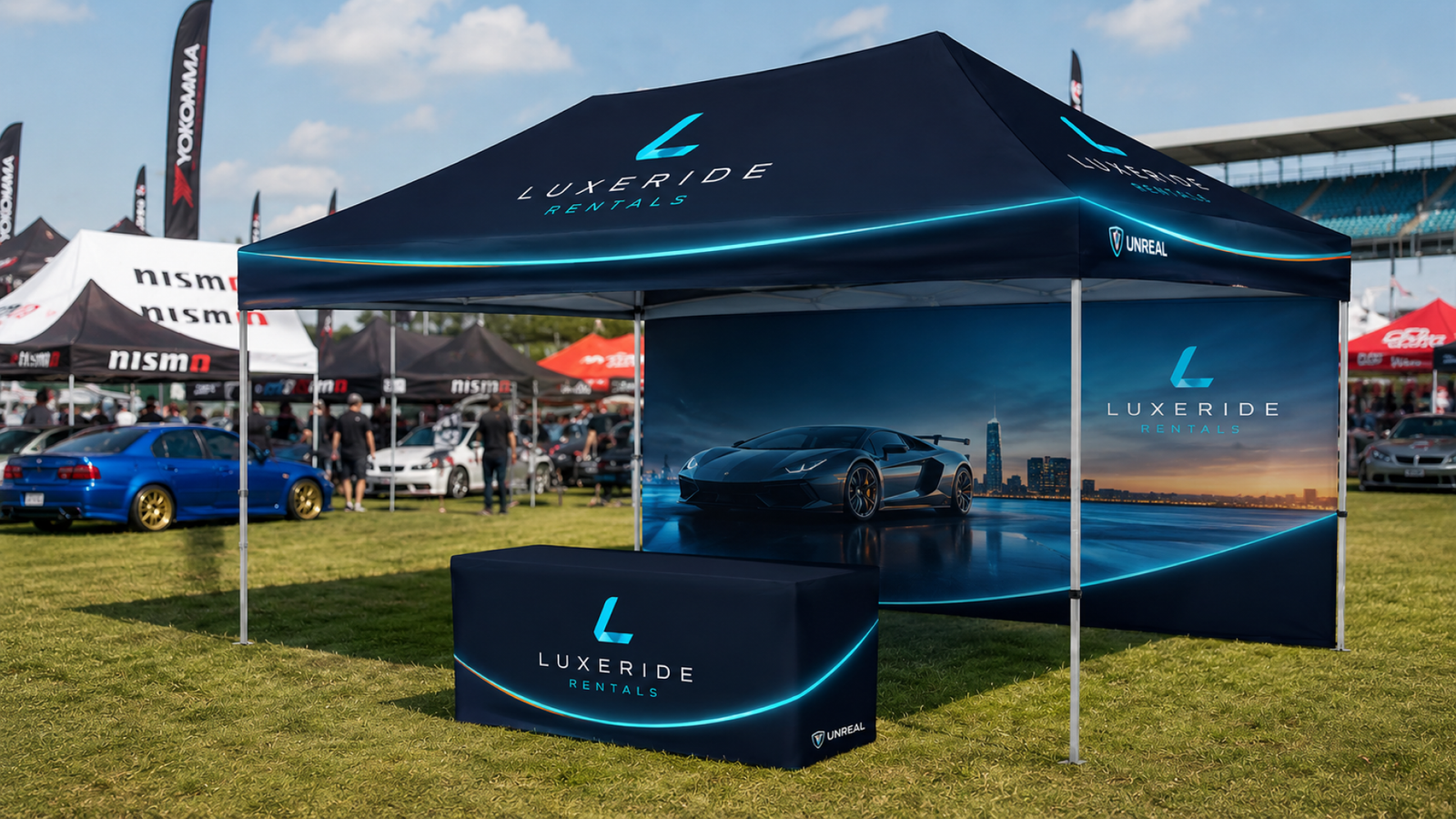
People decide whether to walk toward your booth in about three seconds, usually from ten feet away. Height helps. Color helps. A tall, well-branded canopy tent does more for your visibility than any table sign ever could.
4. Say less, not more
Cramming your mission statement, full product list, and every award you’ve ever won onto one banner? Nobody’s reading that. Pick one line. Make it big. Make it impossible to misread.
5. Give people something to do
A booth with nothing happening is a booth people walk right past. A quick demo, a simple game, a sample table. Anything that gives a stranger a reason to stop for thirty seconds instead of drifting by.
6. Train your staff like it actually matters
Whoever’s standing at your booth is your whole brand for that day. Teach a real opening line instead of “can I help you?” and teach them to ask questions instead of jumping straight into a pitch.
7. Collect contact information, not business cards
A pile of business cards sitting in a drawer isn’t doing anything for anyone. Set up a simple digital form instead, two or three fields, max. The easier you make it to say yes, the more people actually will.
8. Follow up within 48 hours
This is where most small businesses lose the whole event. They collect fifty leads and email them three weeks later, if at all. Follow up while the conversation’s still fresh in their head.
9. Try something a little unexpected
Most booths run the same handful of tactics: a raffle, a bowl of candy, a stack of flyers. If you want to actually get talked about, try one of these instead.
The confession booth
Curtain off a small corner and let visitors anonymously answer one prompt tied to your industry, like their biggest frustration with it. Pin the answers to a wall. It becomes a growing, live display and gives you honest customer insight for free.
The reverse giveaway
Instead of handing something out, ask visitors to give you something small and weird, a doodle, a one-word answer, a pun. The best submission each hour wins a prize. It flips the dynamic from “take my flyer” to “I want in.”
The unfinished booth
Leave a visible blank spot on your backdrop or table cover, a mural, a pin map, a leaderboard, and invite people to help finish it over the course of the day.
Own the sound, not just the sight
Everyone fights for visual attention. A catchy jingle, a live mic doing quick call-and-response, or a “guess the sound” game cuts through a loud hall in a way visuals often can’t.
Borrow someone else’s crowd
Partner with a non-competing exhibitor on a joint scavenger hunt or shared raffle. Their traffic becomes yours, and it feels collaborative instead of salesy.
The no-pitch rule
Train staff to skip the sales pitch for the first sixty seconds of any conversation. Counterintuitive, but it lowers defenses fast and people remember the booths that didn’t sell to them immediately.
10. Invest in your display, not just your product
A great product sitting behind a tired, mismatched setup still looks like a garage sale, whether that’s fair or not. This is usually the first place small businesses cut corners, and it’s the wrong one.
The actual point
None of this needs a bigger budget. It just needs a plan, and maybe one idea nobody else in the room is trying.
Pick the right events. Say less. Give people a reason to stop. Follow up fast. Do that consistently and a small business can genuinely out-market a much bigger one.
If you’re thinking about upgrading your setup this year, start with what gets seen first. It’s worth comparing a few options for a Custom Canopy Tent before your next show. It’s the one piece of your booth that’s already doing its job before you’ve said a single word.
wShow up on purpose. Everything else tends to follow.
Share this content: